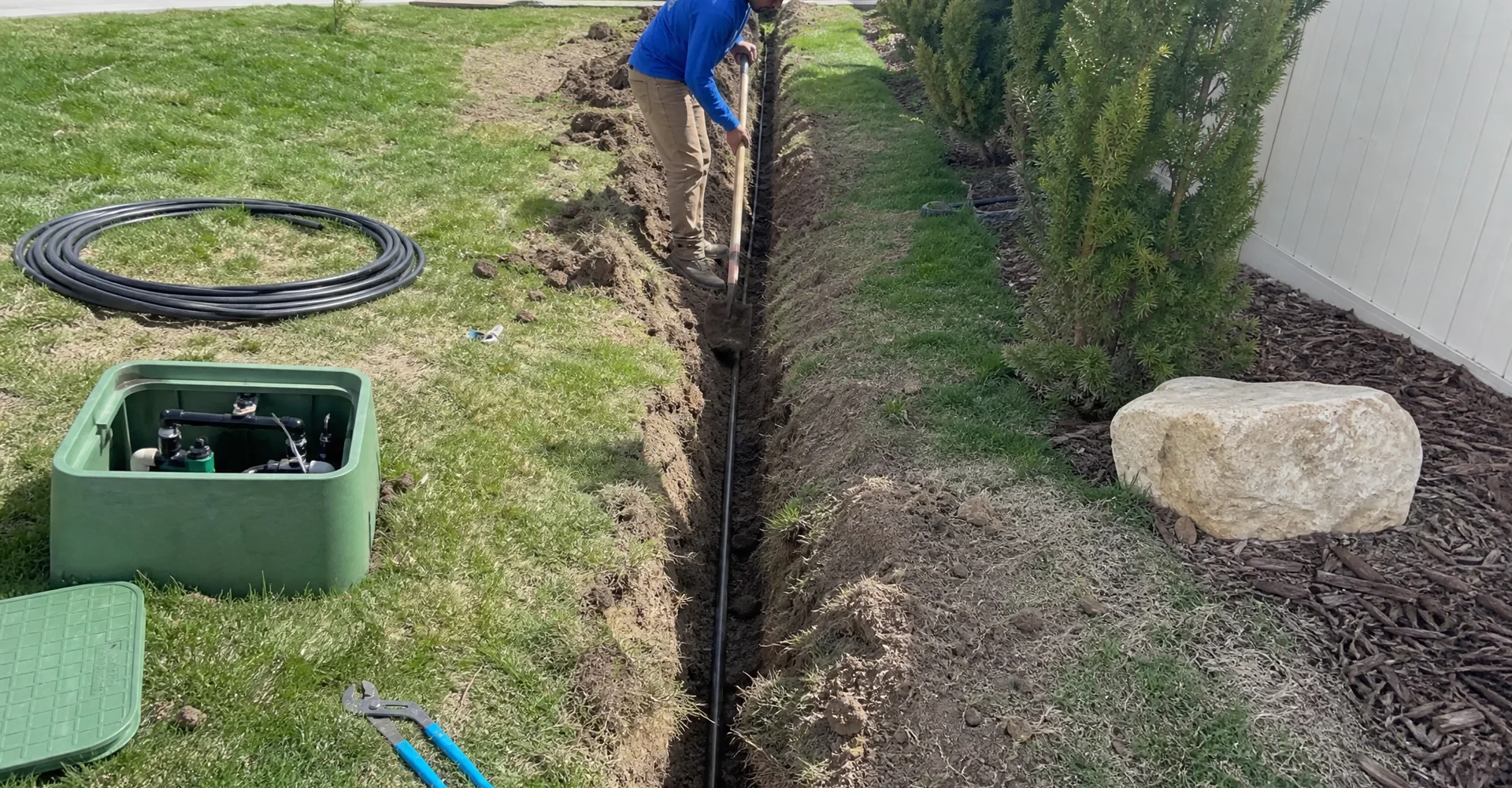
New sprinkler mainline being trenched across a Utah residential yard with the valve manifold box open
Most requested Tooele & Salt Lake valleys

Sprinkler System Installation & Repair in Tooele County

Custom sprinkler system design, installation, repair and replacement, including secondary-water setups, smart controllers and seasonal service.

  • 4.6 on Google (28 reviews)
  • Licensed & insured
  • 8+ years, family-owned
  • From $2,500
4.6 (28 Google reviews)
Licensed & Insured
Fast Response Mon–Fri
1,000+ Utah customers served

What a properly designed sprinkler system does

A sprinkler system has one job: put the right amount of water on the right part of the yard without wasting it. Getting that right is mostly design, not hardware. Zones have to be grouped so every head in the zone has enough pressure to throw its full arc. Lawn, beds and trees need separating because they want completely different watering. And in Utah, the water source itself changes what you build.

We design and install custom systems for residential and commercial properties across the Tooele and Salt Lake valleys, and we repair and replace plenty of systems installed by other people. We also handle the seasonal work: fall blowouts before the freeze, spring startups when the water comes back on.

The Utah-specific piece that trips up out-of-area contractors is secondary water. Much of Tooele County and many valley communities supply untreated irrigation water on a separate line. It’s cheaper to run than culinary water, which is why it’s popular, but it carries sediment and often arrives at pressures that will destroy nozzles. A secondary system needs a properly sized filter, a pressure regulator ahead of the valves, and a disciplined seasonal shutoff. Skip any of those and you’ll be replacing heads every year.

If you already have a system and something is wrong, we diagnose before we quote. Brown patches get blamed on broken heads far more often than broken heads deserve: low pressure, a sunken head, a partially clogged nozzle, a stuck valve, or a zone that was over-loaded when it was built are all more common. Finding the real fault is cheaper for you than replacing parts hopefully.

What’s included

  • Pressure testing and water-source confirmation
  • Custom zone layout, head selection and nozzle sizing
  • Mainline, valve manifold, wiring and controller
  • Filtration and pressure regulation for secondary water
  • Backflow prevention where the connection requires it
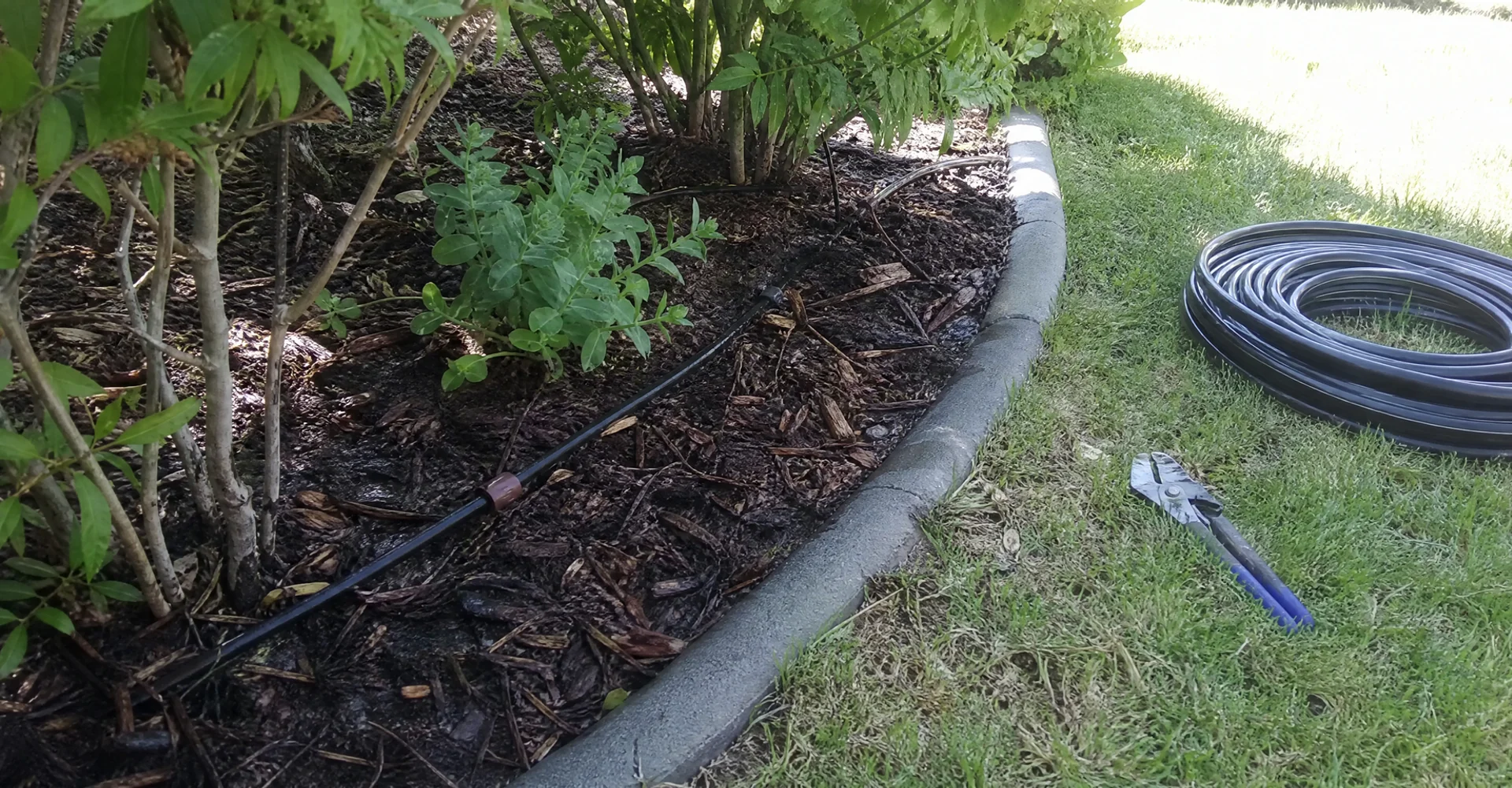
  • Separate drip zones for beds and trees
  • Full coverage test and arc adjustment before handover
  • Controller programming and a seasonal watering plan

Common problems we solve

Dry patches next to soaked ones

Almost always a coverage problem: heads spaced for pressure the system doesn’t have, sunk below grade, or knocked out of alignment. We measure real pressure and fix the layout rather than turning up the run time and drowning the rest of the lawn.

A water bill that jumped for no reason

A stuck valve or a hidden mainline leak runs water continuously without anything obvious showing on the surface. It’s one of the fastest things we find and one of the most expensive to leave.

Clogged and blown heads on secondary water

Sediment in untreated water, or unregulated pressure, or both. The fix is a correctly sized filter and a pressure regulator, plus cleaning the filter through the season rather than once a decade.

Pipes that burst over winter

Manual draining leaves water sitting in low points and valve bodies. It freezes, expands and splits things. A compressed-air blowout done before the first hard freeze is the only reliable protection, and it costs a fraction of a repair.

What affects the price

  • Zone count: driven by yard size, available pressure and head type
  • Water source. Secondary systems need filtration and regulation
  • Trenching distance and how far the mainline has to run
  • Access and obstacles: mature trees, existing hardscape, tight side yards
  • Controller choice. Basic timer versus smart weather-based unit
  • Drip zones for beds and trees added to the design

Where we install and service

Irrigation is our highest-volume service across Grantsville, Tooele, Stansbury Park, Erda and Lake Point, with scheduled runs into Herriman, South Jordan, West Valley City and Kearns.

Our guides go deeper on how a residential sprinkler system works, secondary versus culinary water in Utah, when and why to winterize, and what a sprinkler system costs in Utah.
Transparent pricing

How much does sprinklers cost in Tooele County?

Every job is different, so we price on site rather than off a phone call. These ranges give you a real starting point before we come out.

Repair & service

Diagnostics, repairs, blowouts and startups

from $150

  • Leak and coverage diagnostics
  • Head, nozzle and valve replacement
  • Line repairs
  • Fall blowouts and spring startups
  • Controller programming
Get a free quote
MOST REQUESTED

Standard install

Typical subdivision lot

from $2,500

  • Custom zone and head layout
  • Mainline, valves and manifold
  • Filtration and pressure regulation
  • Controller supplied and programmed
  • Full coverage test and walkthrough
Get a free quote

Large-lot system

Acreage and complex properties

from $6,000

  • Extended mainline runs and extra zones
  • Pressure planning across the property
  • Separate drip zones for beds and trees
  • Smart WiFi controller
  • Coordinated with grading and planting
Get a free quote

Zone count is the main driver, and zone count comes from yard size, water pressure and head type. Repairs and seasonal service are quoted separately and cost far less than a full system. Payment by PayPal, Venmo, Zelle or check.

Why YLC

Why choose YLC for sprinklers?

We diagnose before we quote

Dry patches have several possible causes and only one of them is a broken head. We find the actual fault rather than selling you a system you may not need.

Secondary water expertise

Untreated canal water needs filtration and pressure regulation or it destroys nozzles. We build for the water you actually have, and we know the seasonal shutoff rhythm.

Honest repair vs. replace advice

If three valves and a few heads will fix your system, that's what we quote. We'll tell you when an old system has passed the point where repairs make financial sense, and why.

Coverage tested, not assumed

We run every zone and watch it before we call the job done. Head arcs get adjusted on site, so you don't discover a dry corner three weeks later.

Seasonal service you can book

Fall blowouts and spring startups on the same system we installed, so nothing gets missed and nothing bursts over winter.

Smart controllers that actually save water

Weather-based scheduling skips cycles you don't need. We install and set them up properly rather than leaving you a box and a manual.

How the bids differ

A system designed for your yard vs. a system off a template

Two sprinkler bids can look similar and behave completely differently by August. The differences are mostly in what was measured before the quote.

  YLC install Template bid
Zone count
Set from measured water pressure and yard size
A round number with no reasoning behind it
Secondary water
Filtration and pressure regulation sized to your actual source
Same build regardless of canal or culinary supply
Diagnosis first
We find the actual fault before quoting a replacement
A new system quoted for a problem nobody diagnosed
Coverage
Every zone run and watched, head arcs adjusted on site
Assumed correct; you find the dry corner later
Seasonal service
Fall blowout and spring startup you can book on the same system
Handed over and you find someone else in October

The process

How our sprinklers work runs

  1. 01

    Pressure and source check

    We test your available pressure and confirm whether you're on secondary or culinary water. Everything downstream of that, zone count, head type, filtration, depends on the answer.

  2. 02

    Design the zones

    Heads are grouped so each zone gets enough pressure to throw properly, with lawn, beds and trees separated rather than lumped together.

  3. 03

    Install and test

    Trenching, mainline, valves, manifold, heads and wiring, then a full run of every zone to check coverage and adjust arcs before we backfill and finish.

  4. 04

    Program and hand over

    We set a starting schedule suited to the season and your soil, walk you through the controller, and explain what to change as the weather turns.

Our work

Recent sprinklers projects

Reviews

What customers say about our sprinklers

4.6 stars across 28 Google reviews from homeowners across the Tooele and Salt Lake valleys.

"YLC was professional and helpful from the initial call until the job was done. Had some leaks and multiple sprinkler repairs needed on my front yard and the end results are great!"

xTREX76x

Tooele

"These guys came to the rescue. I needed a sprinkler start-up and they came out quickly. Yovani found a leak in one of my drip systems, fixed it, and helped me set up the timer box. Very professional and friendly."

Michelle

Google Review

"YLC has been very helpful planting our yard, installing our sprinkler system and adding trees. They work hard, stick with promised timelines, and have great suggestions for gardening needs!"

Jan Matthews

Tooele County

Reviews shown are from our verified Google Business Profile.

Got questions?

Sprinklers questions, answered

How much does a sprinkler system cost in Utah?

A standard subdivision lot typically starts around $2,500 and larger or more complex properties run higher. Zone count drives most of it, and zone count comes from yard size, available pressure and head type. Repairs and seasonal service are quoted separately and cost far less.

What's the difference between secondary and culinary water?

Secondary water is untreated irrigation water, usually from a canal or reservoir, supplied on a separate line for outdoor use. It's cheaper to run but carries sediment, so it needs a filter and pressure regulation ahead of the valves, and it gets shut off seasonally. Culinary water is treated city water: cleaner, but you pay drinking-water rates to irrigate with it.

Why does my lawn have dry patches?

Most often clogged or misaligned heads, low pressure spreading a zone too thin, a head that's sunk below grade, or a break in a lateral line. Occasionally it's a zone designed with too many heads to begin with. We test coverage rather than guessing.

Should I repair my old system or replace it?

If the failures are isolated, a couple of valves, some heads, one line, repair is the sensible call. When you're getting repeated line breaks, coverage has never been right, and the controller is beyond saving, replacement usually costs less over a few seasons and cuts water use noticeably.

When should I winterize my sprinklers?

Before the first hard freeze, which in the Tooele Valley usually means mid-to-late fall. Secondary water districts also shut off around then, so book early. Manual draining rarely clears everything; compressed air does, and a burst mainline is far more expensive than a blowout.

Can you add a smart WiFi controller to my existing system?

Usually, yes. Most smart controllers retrofit onto existing valves and wiring. They adjust watering to actual weather instead of running a fixed schedule, which cuts waste, and they're often eligible for water conservation rebates depending on your district.

How many zones does my yard need?

It depends on square footage, available pressure and head type. There's no per-acre rule that works. We measure pressure on site and design zones so every head in a zone actually throws its full arc. Under-zoning is the most common fault we find in systems installed by others.

Do beds and trees need their own zone?

Yes, ideally. Beds and trees want deep, infrequent water; turf wants shorter, more frequent cycles. Running them together means one of the two is always wrong. Drip zones for beds solve it and use far less water.

Do you install backflow prevention?

Yes, where the connection requires it. Protecting the potable supply is not optional, and we set the assembly correctly for your source and configuration.

How long does an install take?

A standard residential system is usually one to two days depending on yard size, access and how much trenching is involved. Large-lot systems with long mainline runs take longer. We give you a real date at the estimate.

Still have a question?

Call or text us Monday to Friday, 8 to 6. We'll give you a straight answer, no pressure.

Free tool

Try our Irrigation System Calculator

Estimate irrigation system costs and water usage for your landscape.

Use the Calculator
YLC Landscaping crew completing sprinkler system installation & repair on a Utah property
Free on-site quotes, Mon–Fri 8–6

Ready to get your sprinklers quoted?

Free on-site estimate with an itemized bid. Mon–Fri 8–6, across the Tooele and Salt Lake valleys.

  • Licensed & insured
  • Itemized, line-by-line bids
  • Family-owned since 2018