
The question behind the question
When people ask whether to repair or replace, what they usually mean is: am I throwing good money after bad? That’s the right question, and the answer depends less on age than on what kind of problems you’re having.
There are two categories of fault, and they point in opposite directions. Either way, the first step is a proper diagnosis. Which is where any sprinkler system installation or repair conversation should start.
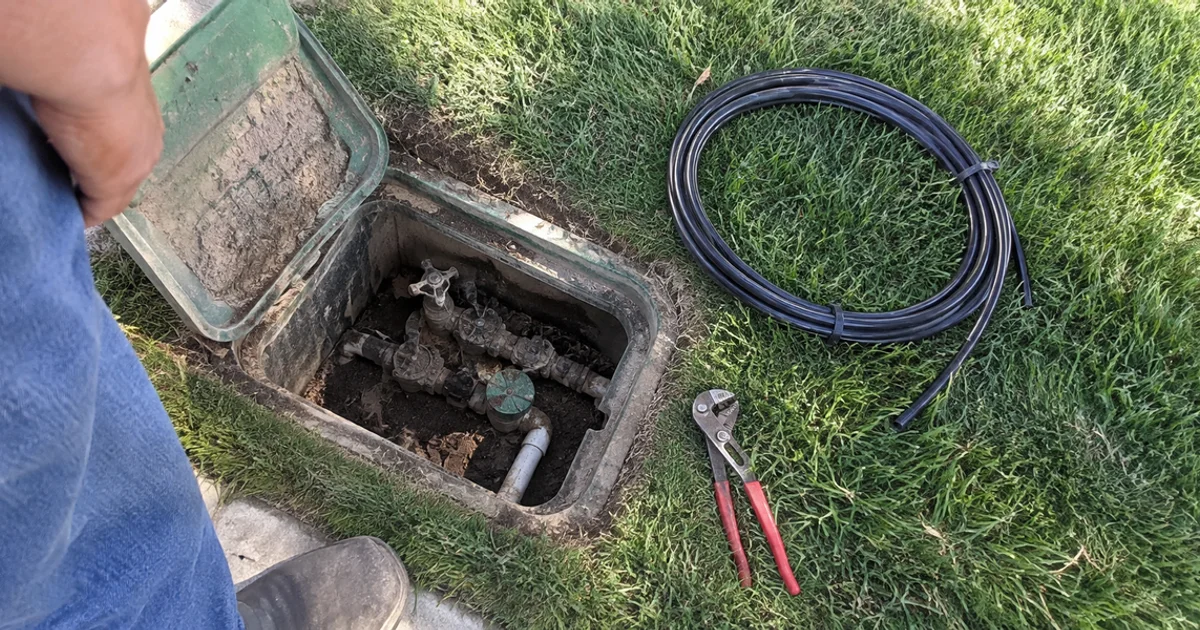
Faults that mean repair
These are wear-and-tear items on a system that was fundamentally well designed:
- A broken or clogged head here and there
- One valve that’s stuck or leaking
- A lateral line damaged by digging or a root
- A controller that’s failed but the wiring is intact
- Filter and pressure issues on secondary water
- Arcs knocked out of alignment
Fix these individually. They’re the normal cost of owning irrigation, and none of them suggest anything is wrong with the system as a whole.
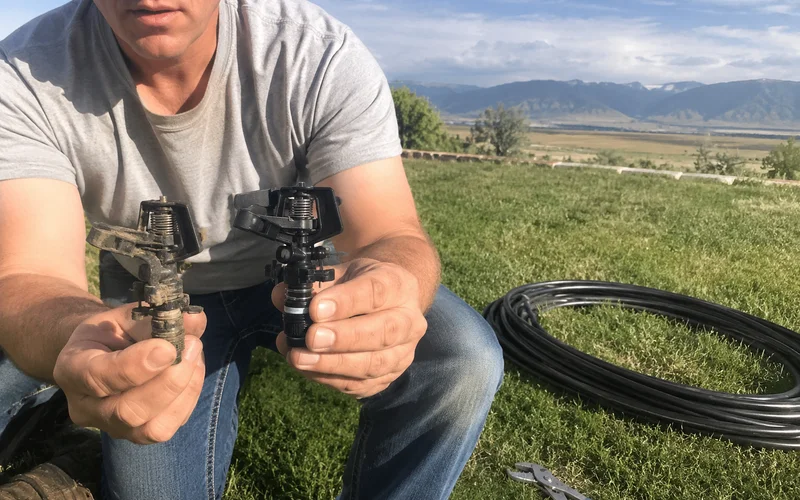
Faults that point to replacement
These indicate a system that was either poorly designed or has aged past its useful life:
- Coverage was never right. If there have always been dry patches in the same places, the zone layout or head spacing is wrong. No amount of head replacement fixes a design fault.
- Repeated line breaks in different places. Once pipe starts failing in multiple locations, the material is at end of life and you’re chasing it.
- Multiple valves failing in succession. Same reasoning.
- Under-zoning. Too many heads per zone for the available pressure. Every head under-performs, permanently, and the only fix is re-zoning. Which is most of a new install anyway.
- No isolation, no drains, obsolete parts. Systems built without serviceability in mind cost more to work on every single time.
- A system that was never winterized properly and has accumulated freeze damage across multiple seasons.
The cost comparison, honestly
| Repair | Replace | |
|---|---|---|
| Per-event cost | Low | High, one time |
| Coverage improvement | None, unless it was a fault | Substantial if design was poor |
| Water efficiency | Unchanged | Better nozzles, correct zoning, smart control |
| Disruption | Minimal | Trenching across the yard |
| Certainty | Fixes the known problem only | Fixes everything at once |
| Best for | Isolated faults on a sound system | Systemic problems or end-of-life pipe |
The arithmetic that matters is cumulative. Three or four repair visits a season on an old system, year after year, adds up to real money, and at the end of it you still have the same coverage problems you started with.
The test we use
If fixing every current fault would give you a system you’re happy with, repair. If you’d fix them all and still have dry patches, high bills or the expectation of more failures next season, that’s a replacement conversation.
What a replacement actually gains you
Correct zoning. Measured pressure, appropriate zone count, every head throwing its designed arc. This is the biggest single improvement on most old systems.
Modern nozzles. Rotating-stream nozzles and better spray heads distribute far more evenly than older technology and are less prone to wind drift.
Beds separated from turf. Almost no old residential system does this. Putting beds and trees on their own drip zones improves plant health and cuts water simultaneously.
Smart control. Weather-based scheduling that skips unnecessary cycles.
Serviceability. Isolation valves, accessible manifolds and drains where they should be, so future maintenance is cheap.
For what a new system costs, our guide on sprinkler system cost in Utah breaks down the ranges and what drives them.
Our approach
We diagnose before quoting either way. If three valves and a few heads will genuinely sort your system out, that’s what we’ll tell you, and it’s a much smaller invoice than a replacement.
Where we do recommend replacement, we’ll show you specifically why: the pressure reading, the zone count that should be there, or the pattern of failures. You should never be told to replace a system without being shown the reasoning.