
The parts, in order
Water travels through a sprinkler system in a fixed sequence, and understanding it makes diagnosing problems far easier. This is the foundation of everything in sprinkler system installation.
The connection and backflow prevention. Your system taps into either the culinary supply or a separate secondary irrigation line. Where it connects to potable water, a backflow prevention assembly stops irrigation water siphoning back into the drinking supply. This is not optional.
Filtration and pressure regulation. On secondary water, a filter catches sediment before it reaches nozzles, and a regulator brings pressure down to what the components are rated for. Systems missing these clog and blow heads.
The mainline. The pressurised pipe running from the connection to the valve manifold. It’s under pressure whenever the system is live, which is why a mainline leak wastes so much water.
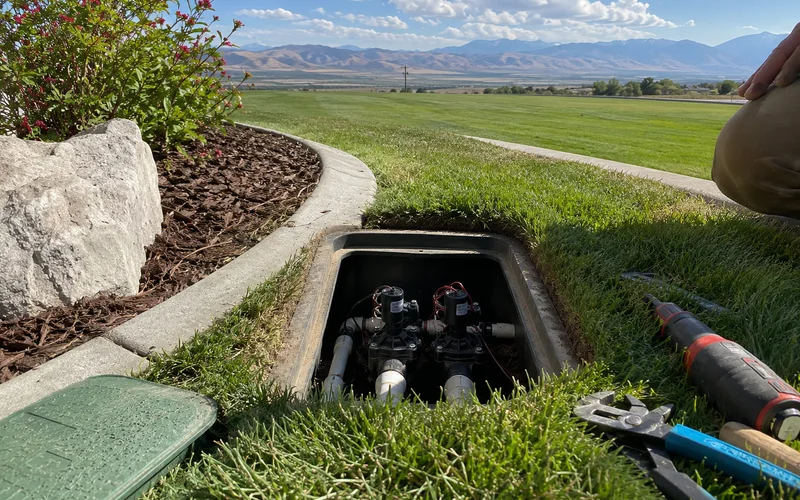
The valve manifold. A box, usually buried in a valve box, holding the solenoid valves. One per zone. When the controller sends power to a solenoid, that valve opens and water flows to that zone’s lateral lines.
Lateral lines. Non-pressurised pipe running from each valve out to the heads in that zone. Only pressurised while the zone is running.
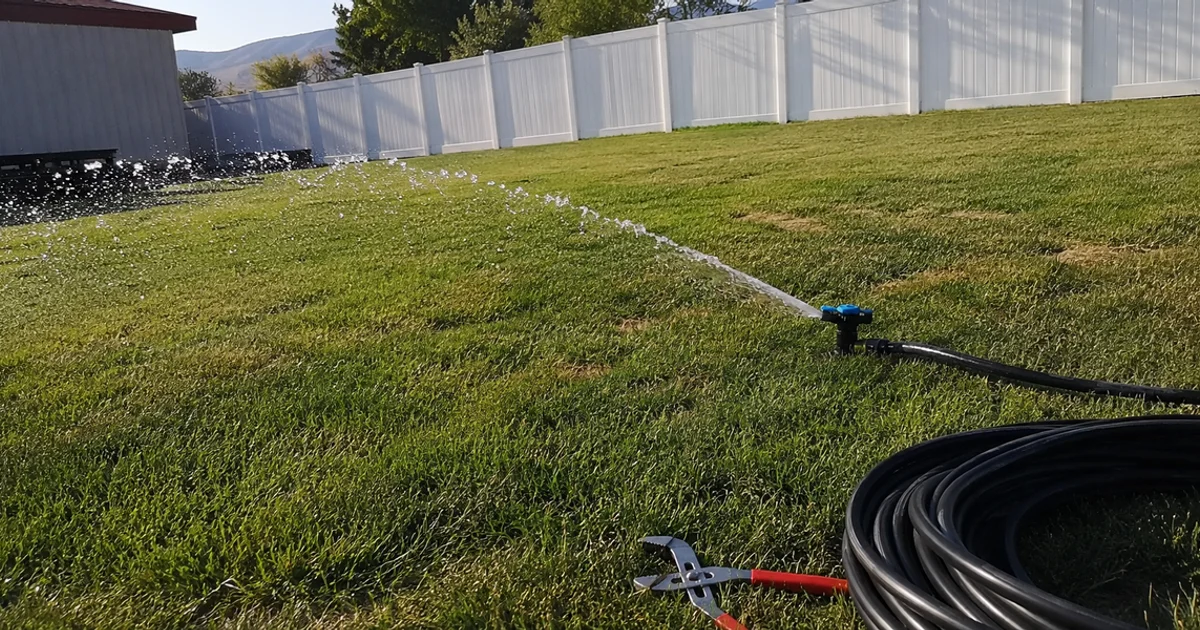
Heads and nozzles. Where water leaves the system. Spray heads throw a fixed pattern over shorter distances; rotors and rotating-stream nozzles cover larger areas more slowly and more evenly.
The controller. The timer that decides which zone runs, when, and for how long. Smart controllers adjust automatically based on weather data.
Why zones exist
The single biggest constraint in any residential system is that your water supply delivers a finite amount of pressure and flow. Run too many heads at once and every one of them under-performs: arcs fall short, coverage gaps open up, and you get dry patches no amount of extra run time fixes.
Zoning splits the yard into groups small enough that every head in the group gets what it needs. The controller runs them one at a time, in sequence.
Zone count therefore comes from measured pressure, yard square footage and the type of heads used. It is not a fixed number per acre. Under-zoning, cramming too many heads onto too few valves, is the most common design fault we find in systems installed by others, and it’s essentially unfixable without rebuilding the zone layout.
Coverage and head-to-head spacing
Sprinkler heads are designed so the spray from one reaches the base of the next. That’s head-to-head coverage, and it exists because sprinkler output isn’t uniform across its arc. It puts down more water near the head than at the outer edge. Overlapping compensates.
Spacing heads further apart to save on parts produces a lawn with a repeating pattern of stronger and weaker growth. It’s one of the clearest tells of a system built to a price.
Diagnosing from the sequence
Whole zone not running? Suspect the valve or the wire. One head not running? Suspect that head or its lateral. Everything running weakly? Suspect pressure at the source. Knowing the order water travels turns guesswork into a short list.
Poly versus PVC
Both are standard in Utah. PVC is rigid, widely used for mainlines, and joins with solvent-welded fittings. Poly is flexible, tolerates ground movement and freeze cycles well, and joins with barbed fittings and clamps.
Neither is universally better. Soil type, pressure, layout complexity and installer preference all factor in. What matters is that the choice is deliberate and the fittings are appropriate. Mixed, improvised connections are where leaks start.
Pressure: the thing everything depends on
Static pressure at your connection determines what the system can do. Too low and heads never throw properly no matter how they’re arranged. Too high and you get misting, wasted water and premature component failure.
That’s why any competent installer measures pressure on site before designing anything. If somebody quotes you a zone count without testing pressure, they’re guessing.
Your water source shapes this too. Our guide on secondary versus culinary water covers what changes between the two and why it matters for design.
Where beds and trees fit
Turf wants short, frequent cycles. Beds and trees want deep, infrequent soaking. A single zone cannot deliver both, which is why beds should be on their own drip zones rather than sharing the lawn’s spray heads. It’s the most common improvement we make to existing systems.