
What a blowout costs
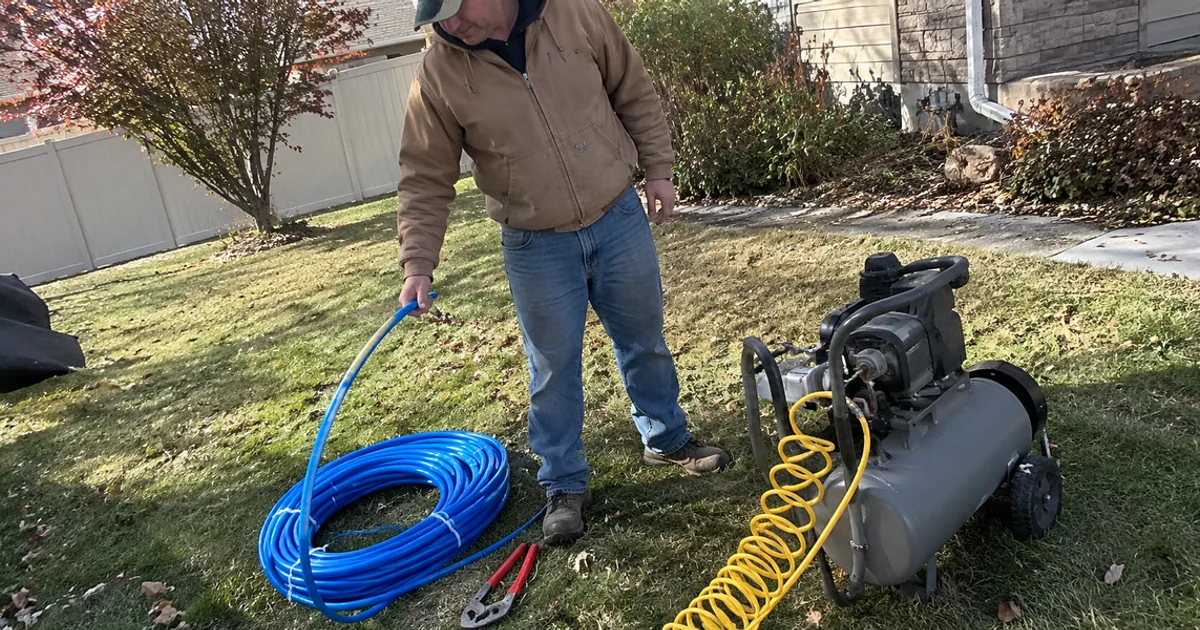
Sprinkler winterization is one of the least expensive services in landscaping and one of the highest-return. Pricing scales with the size of the system rather than being a flat rate, because a three-zone yard and a twelve-zone acreage property take very different amounts of time and compressor capacity.
We quote before booking. For a standard residential system it’s a short visit, and it’s part of the ongoing sprinkler service we provide across the Tooele and Salt Lake valleys.
What affects the price
Zone count. The main driver. Each zone has to be run individually until it clears, so more zones means more time on site.
System size and layout. Long lateral runs take longer to clear than short ones. Properties with multiple manifolds or separated systems take longer again.
Access. How quickly we can get to the connection point, the manifold and the controller.
Backflow assembly type. Some assemblies need specific handling or draining beyond the blowout itself.
Drip zones. These clear differently to spray zones and add a little time.
Travel. Areas close to our Grantsville base are the most efficient for us. We don’t add travel surcharges, but scheduling in batches is why we can keep pricing consistent across the valley.
Why it’s worth well more than it costs
The comparison isn’t blowout cost versus zero. It’s blowout cost versus what freeze damage costs.
A split lateral line means digging up the lawn to find and repair it. A cracked valve body means a rebuild or replacement plus the excavation to reach it. A frozen backflow assembly is typically a replacement, and it’s the most expensive component in the system.
Any one of those exceeds the cost of winterizing by a wide margin, and you often get several at once because everything froze on the same night. You also don’t discover them until you charge the system in spring, by which point water is running into the ground while you find them.
The arithmetic
One blowout costs a fraction of one frozen backflow assembly. There isn’t a scenario where skipping it comes out ahead.
Bundling with spring startup
Booking the blowout and the following spring’s startup together is convenient and generally better value. Two practical benefits:
You’re already on the spring schedule. When secondary water comes back on, everyone in the district wants their system started at once. Having it booked means you’re not calling around in a queue.
Continuity. The same crew that shut the system down brings it back up, knows what’s there, and can flag anything that changed over winter.
Spring startup isn’t just turning a valve. It means charging the system gradually rather than hitting it at full pressure, checking and cleaning filters, and running every zone to confirm nothing failed over the winter.
Booking window
Aim for early to mid fall on the valley floor, and earlier at elevation: Heber City, Midway and Park City get hard freezes noticeably sooner. If you’re on secondary water, plan around your district’s published shutoff date.
The practical advice is simple: book before the weather forecast makes it urgent. Everyone in a district needs this in the same two-week window, and the last few days before a freeze are when availability disappears.
For the full detail on why and exactly when, see our guide on when to winterize.