
The ranges
These reflect what we actually see across the Tooele and Salt Lake valleys. They’re budgeting ranges, not quotes. The number for your property depends on a pressure reading we haven’t taken yet.
| Scope | Typical range |
|---|---|
| Repairs and seasonal service | From around $150 per visit |
| Standard subdivision lot install | From around $2,500 |
| Larger residential system | $4,000 – $6,000 |
| Acreage or complex property | $6,000 – $9,000+ |
For context, sprinkler system installation on a new build is usually the largest single line item on the whole landscape bid.
Zone count is the number that matters
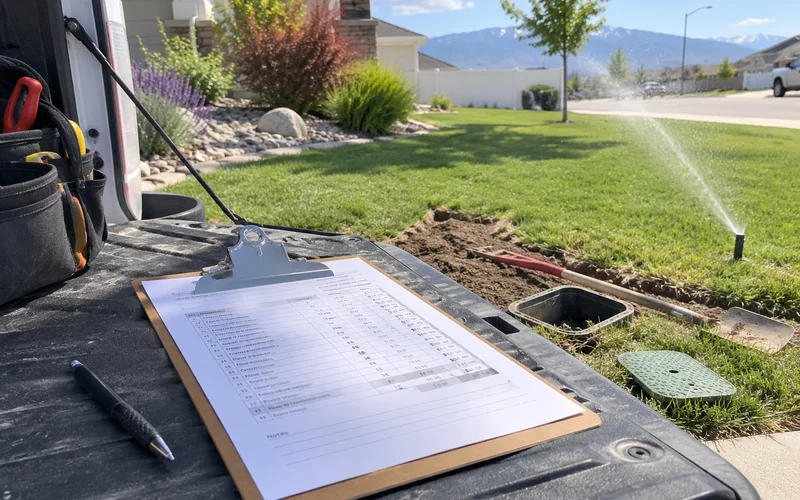
Almost everything about system cost traces back to how many zones you need. Each zone means another valve, another run of wire, another set of laterals and another group of heads.
Zone count isn’t a per-acre rule. It’s determined by:
Measured static pressure at your connection. This sets how many heads can run simultaneously while still throwing their full arc. Low pressure means more zones for the same yard.
Yard square footage and how it’s shaped. A long, narrow lot needs more zones than a compact one of the same area.
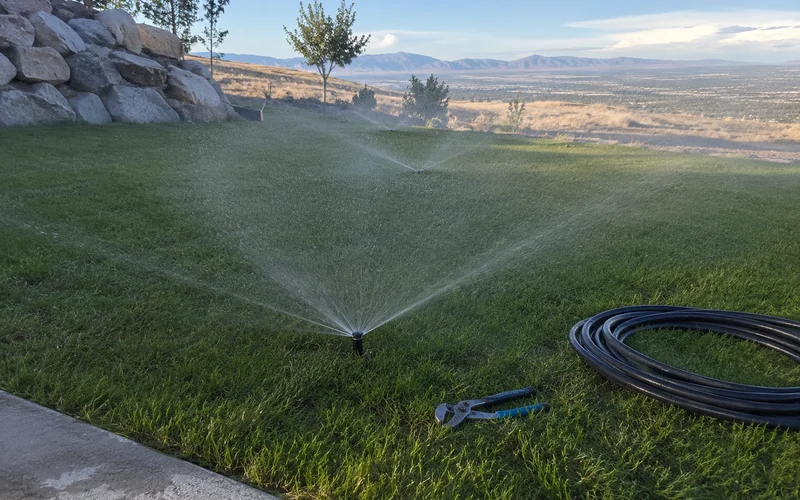
Head type. Rotors cover more ground per head but need more pressure and volume. Spray heads cover less. The mix affects how the zones divide.
Separation of turf and beds. Beds and trees should be on their own drip zones rather than sharing turf spray. That’s an extra zone or two and it’s worth it.
Any contractor quoting zone count without measuring pressure is guessing, and guessing low is how you end up with a system that never covers properly.
Secondary versus culinary cost factors
Secondary water adds a properly sized filter and a pressure regulator to the install. Modest hardware cost, and non-negotiable. Untreated canal water will clog nozzles and jam valves without them.
Culinary water connections typically require backflow prevention appropriate to the configuration, which has its own cost.
Install costs land in broadly similar territory. Where secondary wins decisively is on running cost: untreated irrigation water is substantially cheaper per volume than treated drinking water, and over a Utah summer that difference is meaningful for anyone with a real lawn.
What else moves the number
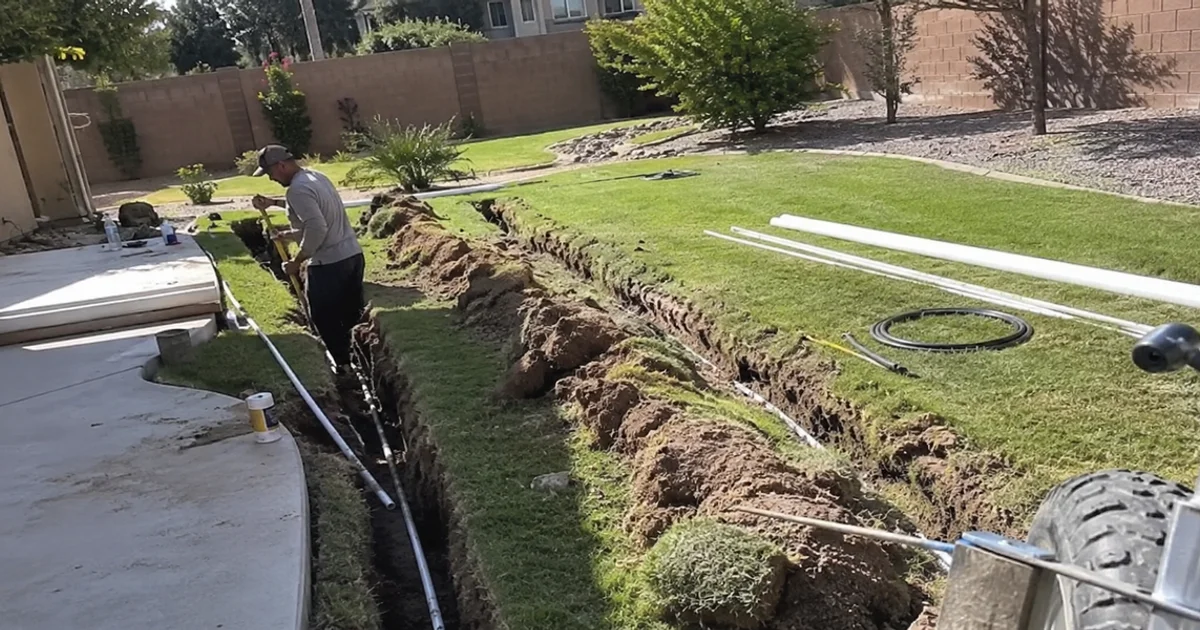
- Trenching distance. How far the mainline runs from the connection to the manifold, and how far laterals extend.
- Access and obstacles. Mature trees, existing hardscape, tight side yards and anything requiring hand digging.
- Soil conditions. Rocky ground slows trenching considerably, and much of Tooele County is rocky.
- Controller choice. A basic timer versus a smart WiFi controller.
- Retrofit versus new build. Installing into an established landscape means working around what’s there and repairing the surface afterwards.
- Drip zones for beds and trees added to the design.
What’s included in our installs
Every system we install includes pressure testing and water-source confirmation, zone design, mainline and valve manifold, wiring, heads and nozzles sized to each zone, filtration and pressure regulation where the source requires it, backflow protection where applicable, controller supply and programming, and a full coverage test with arcs adjusted before we call it done.
That last item catches things. Running every zone and watching it is how you find the head that needs a quarter-turn, and it’s the difference between a system that works and one that mostly works.
Where cheap bids cut
Almost always zone count. Fewer valves and fewer heads is the fastest way to lower a number, and the customer doesn’t discover the consequence until the following August when the dry patches show. Ask any bidder what pressure they measured and how many zones that supports.
Repairs and seasonal service
Individual repairs, blowouts and spring startups are quoted separately and cost far less than a system. A blowout on a standard residential system is a short visit, and sprinkler blowout cost in Utah covers what to expect there. Repairs depend entirely on what’s wrong, which is why we diagnose before quoting.
Getting your number
The variable that moves your cost most, available pressure, takes five minutes to measure and can’t be guessed from a photo. Our on-site estimate is free, and the bid comes back itemized so you can see zones, valves, heads, trenching and controller priced separately.
Get a free estimate and use it as a benchmark against whatever else you’re holding, even if you go elsewhere.