
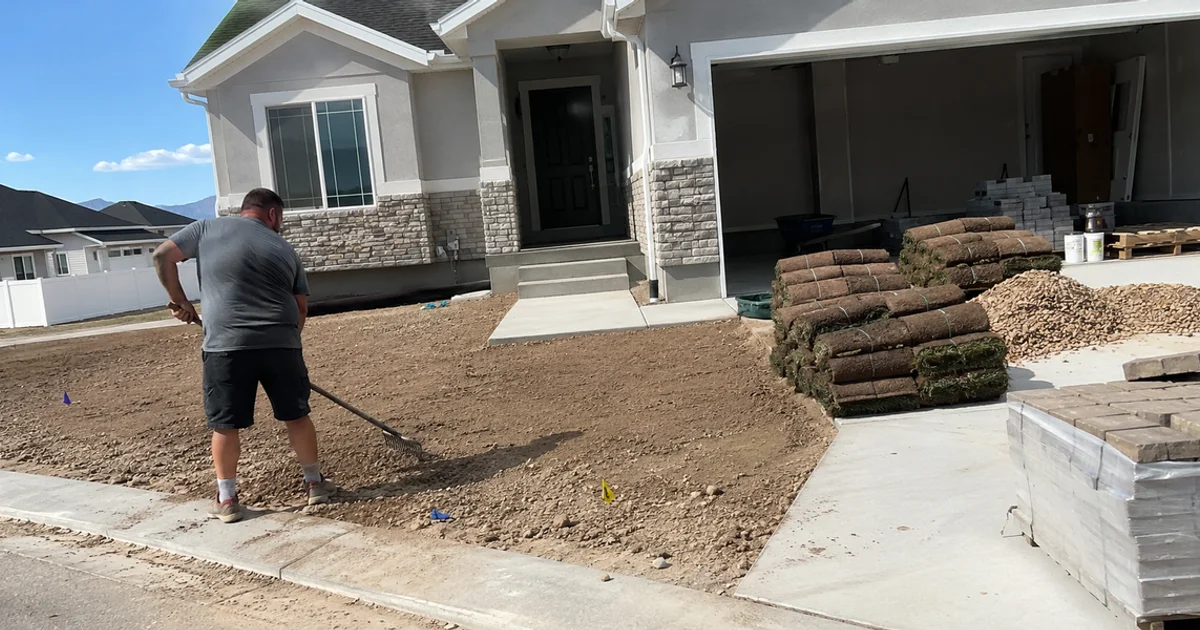
The short answer: everything from bare dirt to a finished yard
If you’ve just closed on a new-build home in the Tooele or Salt Lake valleys, the yard is probably compacted dirt with a survey stake in it. A full new-construction install takes that from where it is to a finished, irrigated, planted landscape in one coordinated job. That’s exactly what our new-construction landscaping service covers.
Here is the line-item scope, in the order the work actually happens.
Site clearing. Construction leaves things behind: offcuts, wire, chunks of concrete, sometimes buried debris. It comes out before anything else, because anything left under the surface settles unevenly later.
Rough and finish grading. The grade gets set so water runs away from the foundation and out of window wells, not toward them. Builders grade for construction access, not for your landscape, and marginal slopes often reverse as the ground settles in the first couple of years. Finish grading then produces the smooth, rock-free surface that sod actually needs.
Soil preparation. New-build ground is heavily compacted by construction traffic and usually stripped of good topsoil. We rip the compacted layer, screen out rock, amend where needed, and bring in screened topsoil so roots have somewhere to grow.
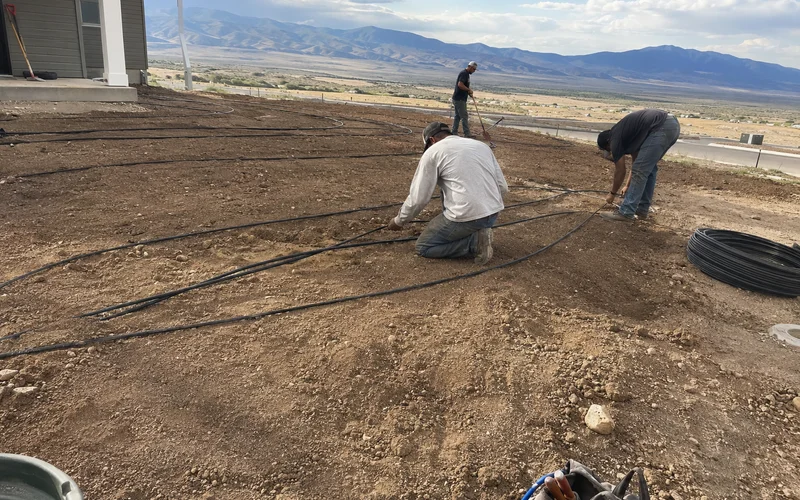
Irrigation. A designed system: mainline, valve manifold, zones, heads, wiring and controller, sized to your yard’s square footage and, critically, your actual water source. Beds and trees get their own drip zones rather than sharing the lawn’s schedule.
Sod or seed. Quality palletized sod laid on the prepared surface with tight staggered seams, cut cleanly to bed lines and rolled in. Seed is an option where it suits the project and budget better.
Trees, shrubs and planting. Species chosen for our alkaline soil, wind exposure and hardiness zone, placed for their mature size rather than how they look on delivery day, planted with proper bed prep.
Edging and gravel. Steel, poly or concrete curbing to hold a crisp line, quality geotextile fabric, and decorative rock spread to a depth that actually suppresses weeds.
Programming and handover. We set the controller for the season, walk the yard with you, and leave a written watering and establishment plan.
What’s standard and what’s optional
Standard on essentially every full install: clearing, grading, soil prep, irrigation, sod, bed edging, gravel and controller setup. Those are the elements that make the yard function, and skipping any of them creates a problem you pay for later.
Optional, and priced separately so you can decide: hardscape like a paver patio or seating wall, a retaining wall or terracing where the lot has a real grade change, landscape lighting, extended planting beyond the basics, a smart WiFi controller instead of a standard timer, and drip conversions if you want more water-wise beds than turf.
The one that surprises people is topsoil volume. Two lots on the same street can need very different amounts depending on what the builder left. It’s a real line item, not padding, and it’s the thing most often missing from a suspiciously cheap bid.
Rough timeline
A front yard on a standard subdivision lot is often a few days once we start: grading and irrigation, then soil and sod, then beds and edging. Front and back together usually runs about a week. Larger lots, extensive irrigation runs, or added hardscape stretch it further. Frozen or saturated ground genuinely stops sod and grading work, and we tell you as soon as that’s on the cards rather than letting a date quietly slip.
Why bundling it avoids gaps
The sequence matters more than any individual step. Irrigation has to go in before topsoil. Grading has to be right before irrigation. Bed lines have to be set before gravel. When four contractors handle those on four schedules, the seams are where things go wrong, and when something does, everybody points somewhere else.
Running the whole sequence with one crew means the grade the irrigation was designed for is still the grade when the sod arrives, and there’s one number to call if anything needs sorting. It’s also cheaper per square foot, because mobilising equipment once instead of four times is real money.
If you’d rather see the whole sequence step by step, our guide on the blank dirt to finished yard process walks through each stage and what you decide at each one.
Once you know roughly what scope you want, the next step is a free on-site visit. We walk the lot, look at the soil and the water source, and put an itemized bid together so you can see every line before committing to anything.