
What makes rural lots different
Suburban retaining wall work is mostly modest walls on small lots with easy access. Rural Tooele County is a different problem, and it’s a big share of our retaining wall work.
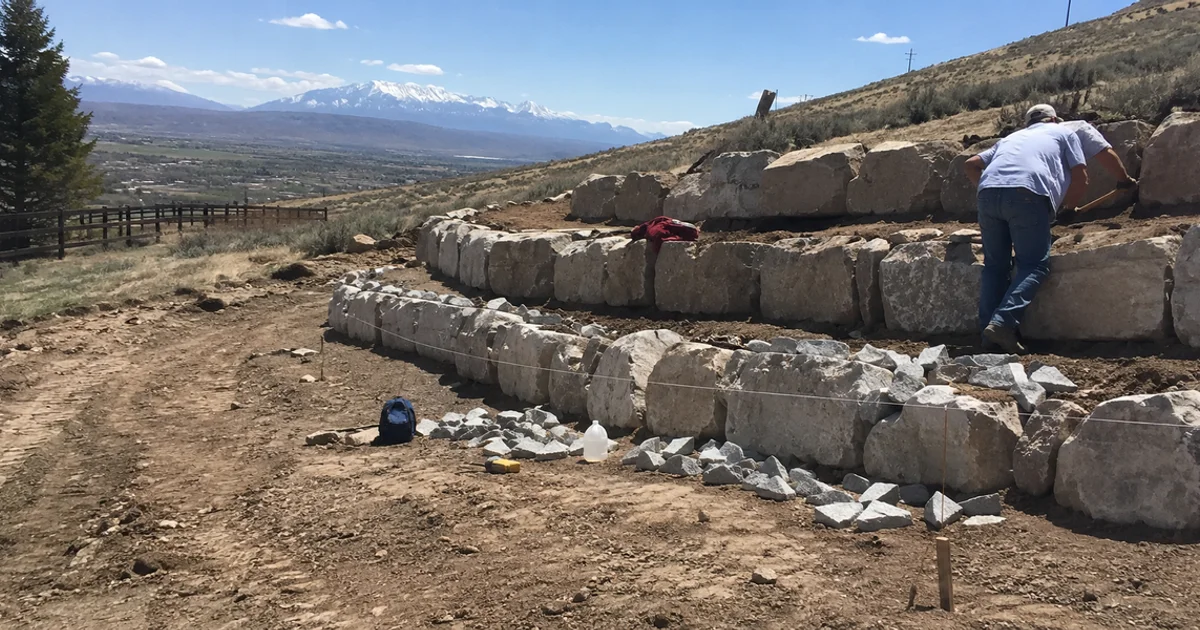
Grade changes are larger. Properties in Erda, Pine Canyon and out toward the benches sit on real topography. A house cut into a hillside leaves a bank behind it that can be substantial.
Runs are longer. On an acre or more, the grade change extends across the property rather than stopping at a fence line thirty feet away. You’re building linear feet.
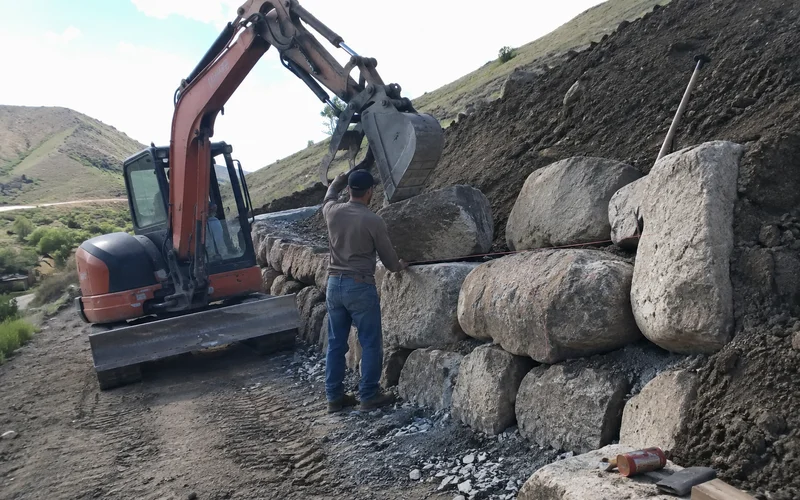
Ground is rocky. Excavation for footings and drainage takes longer and sometimes takes different equipment.
Water arrives from uphill. Suburban lots mostly deal with rain landing on them. Rural hillside lots also deal with everything running down from above, which is a much larger volume during snowmelt.
Access is usually good. The one thing that gets easier. Wide frontage and open ground mean machines and material deliveries can reach the work, which lowers cost per linear foot compared to a tight subdivision back yard.
Terracing beats one tall wall
When the grade change is significant, the instinct is to build one wall tall enough to hold it. That’s usually the wrong call.
Structurally, wall height drives everything: base depth, drainage volume, and the amount of geogrid reinforcement extending back into the slope. Doubling the height more than doubles the engineering demand.
Financially, two shorter walls stepped up a slope commonly cost less than one wall of the combined height, because each stays within simpler design parameters.
Visually, a single tall wall dominates a rural property in a way that reads as infrastructure. Stepped terraces with planting between them look like landscape.
Practically, terracing creates level planted beds you can actually use, rather than a flat area at the top and a wall face at the bottom.
The trade-off is footprint. Terracing consumes horizontal distance, so it needs slope depth to work with. On a rural lot you usually have it. It also changes the budget picture, since walls are priced by face area — see how much a retaining wall costs in Utah for the ranges.
Managing the water first
On a hillside lot, the wall is only part of the answer. Before we design it we look at where water is coming from and where it’s going.
That means grading to shape the slope, cutting swales where runoff concentrates so it’s carried past the wall rather than into it, and checking whether anything uphill (a neighbouring property, a driveway, a roof) is directing volume at the work.
A wall built without addressing upslope water is a wall doing more work than it should have to, for longer than it needed to.
The rural-lot sequencing
Clearing first if the slope is overgrown, then grading and drainage, then the wall, then planting into the terraces. Skipping straight to the wall means building it to a grade that’s about to change.
Boulder walls and rural character
On a property with open ground, native rock and a mountain backdrop, natural boulder and fieldstone walls look like they belong. Manufactured block can read as imported.
Basalt, granite and fieldstone all work here. Beyond appearance, boulder walls are naturally permeable. Water finds its way between stones rather than building against a solid face, and the gaps make planting pockets that root into the slope and help stabilise it.
The honest limitation: boulder walls suit decorative and low-retaining applications. Where a slope has genuine load behind it, an engineered segmental system with proper reinforcement is the right specification, and we’ll say so.
Erosion control after the wall
A wall stops the slope moving at that line. Everything above it still needs to hold together.
Planting the terraces with deep-rooting, drought-tolerant species does that work, and it’s what turns a stepped construction into landscape. Mulch or gravel over fabric on the beds reduces surface movement while planting establishes.
On rural lots we’d rather over-plant the terraces than under-plant them. Bare ground on a slope in a Utah spring is temporary ground.