
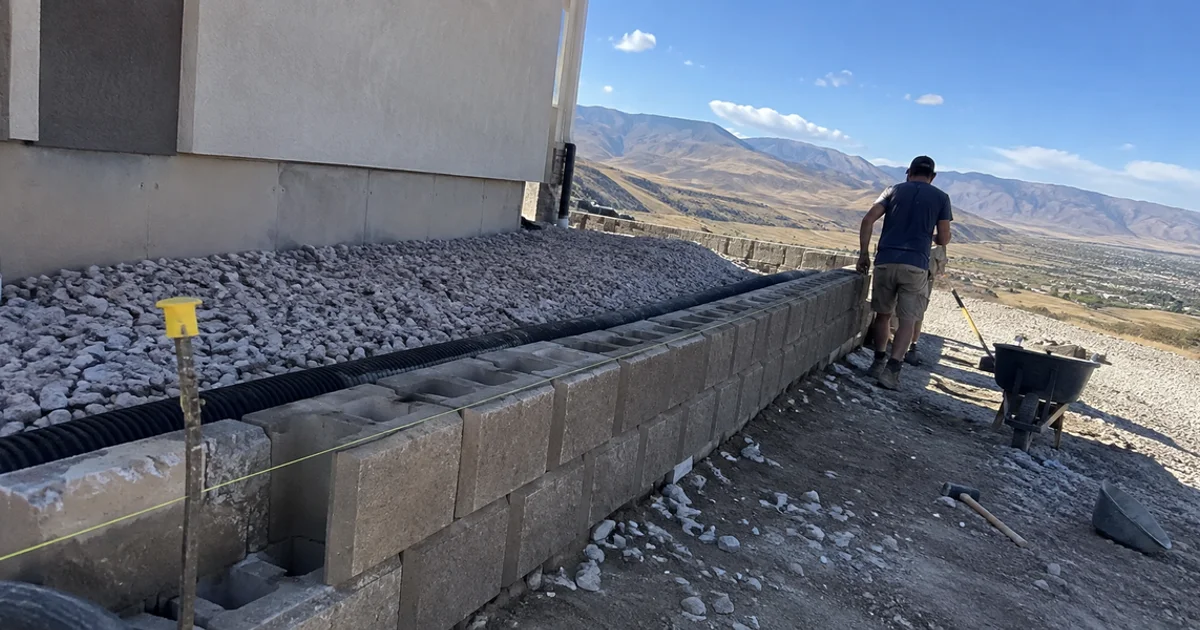
The failure mode you’re preventing
Retaining walls almost never fail because the blocks weren’t strong enough. They fail because of water.
Here’s the mechanism. Soil behind a wall absorbs water, from rain, irrigation, snowmelt, or runoff from higher ground. Saturated soil is dramatically heavier than dry soil, and the water within it exerts hydrostatic pressure in every direction, including horizontally against the back of your wall.
That pressure builds. In our climate it also freezes, expands and thaws repeatedly through winter, working the wall a little further out each cycle. What you observe is a wall that starts to lean, then bulges in the middle, then displaces blocks, then comes down.
Preventing it is the entire purpose of the drainage system in every retaining wall we build.
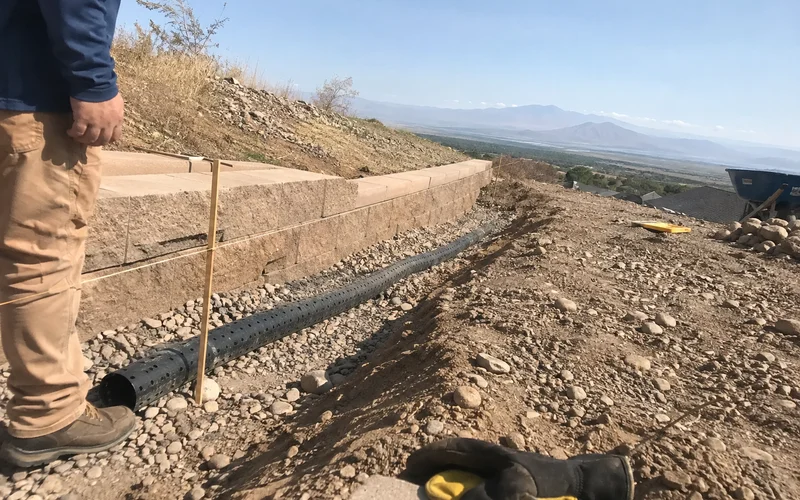
The four components
Drain rock. Clean, angular gravel with the fines washed out, backfilled in a zone directly behind the wall face. The gaps between stones let water move freely downward instead of being held in soil against the wall. This is the primary path.
The word “clean” matters. Gravel with fine material mixed in clogs over time and stops draining, which puts you back where you started with an extra layer of expense.
Perforated drain tile. Pipe with holes or slots, laid at the base of the drain rock zone, running the length of the wall and pitched to an outlet. Water arriving down through the drain rock enters the pipe and gets carried away to somewhere safe: daylight at the end of the wall, a drain, or a lower part of the property.
Without an outlet, drain tile is just a pipe full of water. Where it discharges is as important as the pipe itself.
Filter fabric. Geotextile separating the drain rock from the native soil behind it. Its job is to let water pass while stopping soil fines from migrating into the gravel and clogging it. This is what makes the drainage system last decades rather than years.
Weep holes. Openings through the wall face that let any water reaching the front escape rather than accumulating. They’re the backup, not the primary system. A wall with weep holes and no drain rock is a wall with decorative holes in it.
The base, which is drainage-adjacent
A compacted road-base footing under the first course does two things: it spreads the load, and it gives the wall a stable, well-draining foundation that won’t settle unevenly.
Walls built directly on undisturbed native soil settle differentially. Once the base moves, the courses above it lose alignment, joints open, and the whole structure starts working against itself.
How to spot a bid missing drainage
Ask what’s going behind the wall. The answer should mention clean drain rock, perforated tile with a specified outlet, and filter fabric, without you having to prompt. If the answer is “we backfill with the soil that came out,” you have your explanation for why that bid is cheaper.
Where water actually comes from
Worth thinking about before the wall is designed:
- Rainfall on the slope above the wall
- Irrigation on planted areas uphill. This is a big one and it’s continuous through summer
- Snowmelt, which in a Utah spring arrives in volume over a short period
- Runoff from adjacent properties or hardscape upslope
- Roof drainage if downspouts discharge anywhere near the wall
Managing the water before it reaches the wall (grading, swales, redirecting downspouts) reduces what the drainage system has to handle. On larger walls we design both together.
What maintenance looks like
Minimal, but not zero. Keep the drain tile outlet clear so water can actually leave. Watch for any sign of movement or bulging, particularly after a wet spring. Keep irrigation above the wall reasonable, since over-watering a bed on top of a wall is a slow-motion version of the failure mode above.
Done properly, that’s the extent of it. Which is why our guide on how long walls last puts drainage at the top of the list of what determines lifespan.