
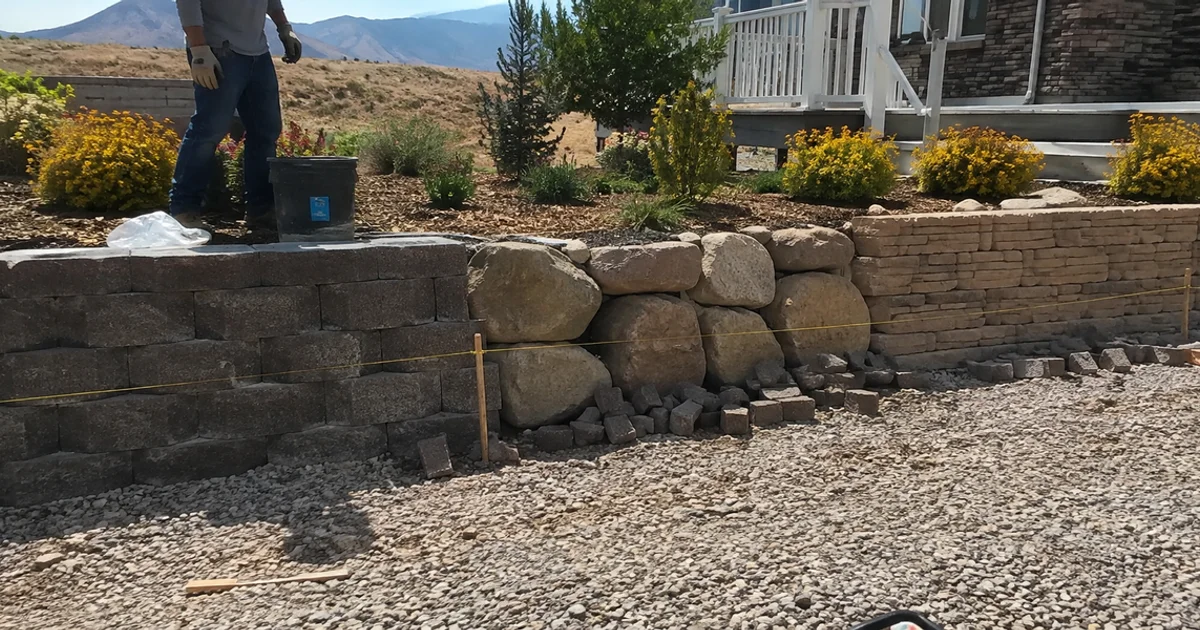
The three options
There’s no universally best material for a retaining wall. There’s a best fit for a given height, budget, site and property character. Here’s how the three we build compare.
Segmental block
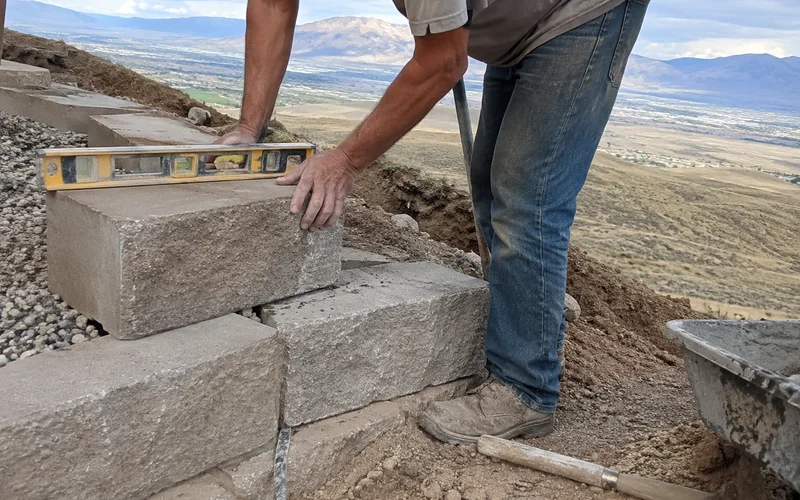
Manufactured interlocking concrete units, produced to consistent dimensions and strength, designed specifically for retaining applications.
Strengths. Predictable engineering: manufacturers publish design tables for height, reinforcement and setback. Fast to lay because units are uniform. Clean, regular appearance. Generally the most cost-effective at standard residential heights. Wide range of colours and face textures.
Limits. Can look manufactured on a rural or natural setting. Colour is a fixed choice you’re committed to. Very tall walls need substantial geogrid reinforcement, which extends the excavation depth behind the wall considerably.
Best for. Subdivision lots, walls that need to be engineered to a known standard, budget-conscious projects, and anywhere a clean modern line suits the house.
Boulder walls
Large natural stones, commonly basalt, granite or fieldstone in this region, bedded and stacked to hold grade.
Strengths. Looks native, particularly on rural and hillside properties where the surrounding landscape is stone. Extremely durable as a material. Gaps between stones create planting pockets that soften the wall and root into the slope. Naturally permeable, so water finds its way through rather than building pressure the way it does behind a solid face.
Limits. Needs machine access. You cannot place large boulders by hand. Cost swings widely with stone size and how much machine time placement takes. Less predictable engineering than block, so for tall structural applications block is often the safer specification. Takes up more depth for the same height.
Best for. Rural and acreage properties, hillside lots, decorative and low-retaining applications, and anywhere the setting calls for natural material.
Natural cut stone
Quarried and dressed stone laid in courses, either dry-stacked or mortared.
Strengths. The most refined natural look available. Very long-lasting. Suits traditional and high-end properties. Can be worked to fit precisely.
Limits. The highest labour cost of the three by a clear margin, because each piece is placed and fitted individually. Availability and price vary with quarry supply.
Best for. Feature walls, front-of-house applications, and projects where appearance is the priority and budget allows.
Side by side
| Segmental block | Boulder | Natural cut stone | |
|---|---|---|---|
| Typical cost | Lowest | Middle, variable | Highest |
| Speed to build | Fastest | Moderate | Slowest |
| Engineering predictability | Highest | Moderate | Moderate |
| Look | Uniform, modern | Rugged, native | Refined, traditional |
| Suits rural lots | Less well | Very well | Well |
| Suits subdivision lots | Very well | Sometimes | Well |
| Machine access needed | Helpful | Essential | Helpful |
| Planting pockets | No | Yes | Limited |
Fit by wall height
Low walls, under roughly waist height. Any of the three works. This is where aesthetics can lead the decision, because the structural demands are modest.
Mid-height structural walls. Segmental block with geogrid reinforcement is the most reliable and usually most economical specification. Boulder walls are possible but need more depth and careful engineering.
Tall walls. Engineered segmental block with substantial reinforcement, or a terraced approach using multiple shorter walls. Terracing is frequently the better answer: structurally simpler, visually less imposing, and it creates usable planted levels.
What actually determines lifespan
Not material. Drainage and base preparation. A block wall with proper drain rock, drain tile and a compacted footing outlasts a boulder wall built on undisturbed soil with no drainage, every time. Material affects appearance and cost far more than durability.
What we’d recommend
On a subdivision lot, block. On a rural Erda or Pine Canyon property, boulder. On a feature wall at the front of a nice house where budget allows, cut stone. On anything tall, terrace it.
For what any of them cost, see our guide on retaining wall cost in Utah.