
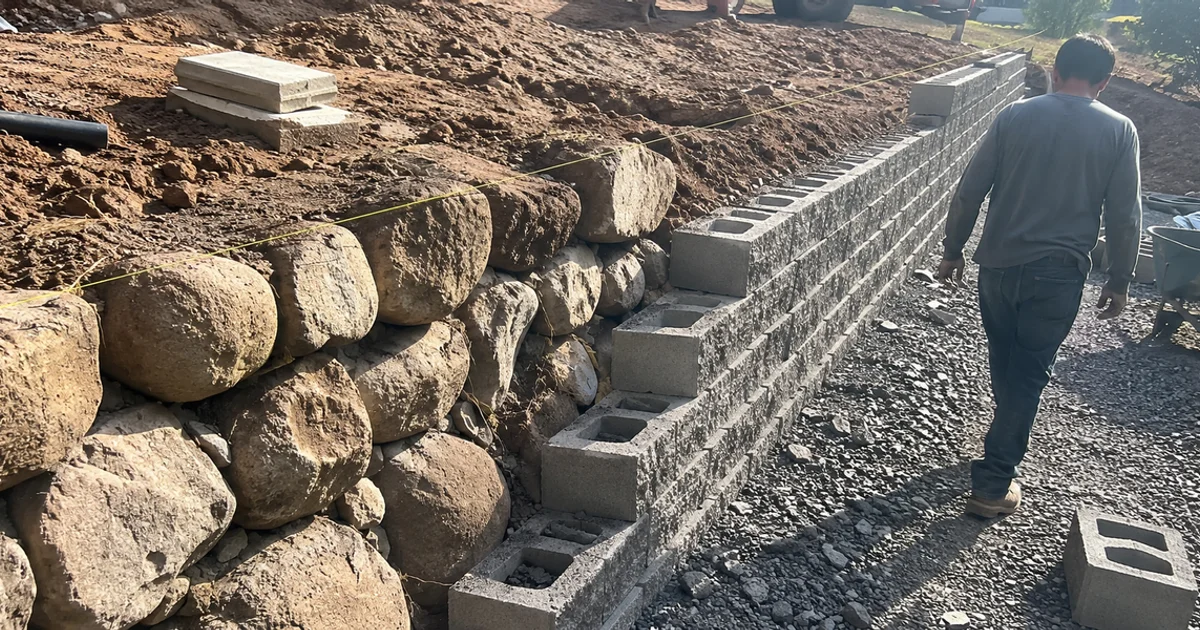
They’re answering different questions
This isn’t really a like-for-like comparison. One is a structural element and one is a landscape feature that happens to be made of stone. Confusing them is how walls fail.
A retaining wall is built to hold back grade. It has a compacted base, a drainage envelope, correct batter, and reinforcement sized to the height and load. It’s engineering that happens to be visible.
A rock wall is natural boulders or fieldstone bedded and stacked, usually to define an edge, add character, or hold a modest bank. Placement is a craft, but it isn’t engineered to a load.
The right question isn’t which you prefer. It’s what the wall has to do.
Deciding by function
| Retaining wall | Rock wall | |
|---|---|---|
| Holds significant grade | Yes | No |
| Light retaining | Yes | Yes |
| Decorative edging | Overkill | Ideal |
| Engineered to a load | Yes | No |
| Drainage system | Full envelope required | Naturally permeable, still needs planning |
| Base preparation | Compacted road base, essential | Bedded stones, less critical at low height |
| Planting pockets | Limited | Yes, between stones |
| Suits rural setting | Depends on material | Very well |
| Suits subdivision lot | Very well | Sometimes |
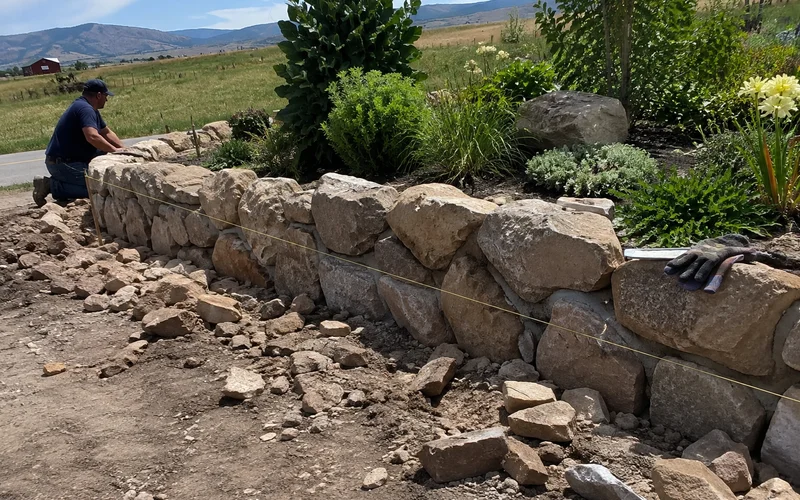
When a rock wall is the right call
- Defining a bed or driveway edge where there’s little or no grade being held
- A modest bank that’s stable but would benefit from some structure and planting pockets
- Rural and hillside properties where natural stone matches the setting
- Accent and character work. A boulder grouping or a low wall that gives an open yard some form
- Slopes where you want planting in the wall itself, which the gaps between stones allow
When it has to be an engineered retaining wall
- Anything holding meaningful height with soil behind it
- Slopes that are actively moving or eroding
- Where anything loads the ground above: a driveway, a structure, a parking area
- Where water collects behind the wall and pressure will build
- Where a failure would be dangerous or damage a building
The honest version: if you’re unsure which category you’re in, assume structural. The cost of over-building a wall is money. The cost of under-building one is the wall, plus the slope, plus whatever the slope lands on. If you’re still working out whether the grade on your property calls for one at all, start with when does a yard need a retaining wall.
What we’ll tell you on site
If a boulder wall genuinely does the job, we’ll build one: it’s usually the easier and often cheaper build, and on a rural lot it looks better. But we won’t build one where the slope needs engineering just because it’s what was asked for. That’s a conversation worth having before the estimate, not after the wall moves.
Cost, realistically
At low heights with good machine access, boulder walls can be very cost-effective. The material is straightforward and the labour is placement rather than construction.
As height increases, that flips. Boulder walls need progressively larger stone and more depth to hold the same grade, while segmental block scales predictably with reinforcement. At structural heights, engineered block is usually the more economical specification as well as the more reliable one.
Machine access swings boulder cost more than anything else, because you cannot place large stone by hand. A boulder wall in a location the excavator can reach is affordable; the same wall in a spot requiring careful manoeuvring is not.
The hybrid answer
Plenty of properties end up with both, and that’s often the best outcome. An engineered block wall does the structural work where the grade demands it, and boulder or fieldstone handles the decorative edges, bed definition and accent work elsewhere.
On rural Tooele County lots that combination reads well: the structural wall solves the problem, and the natural stone ties the whole yard to its setting.