
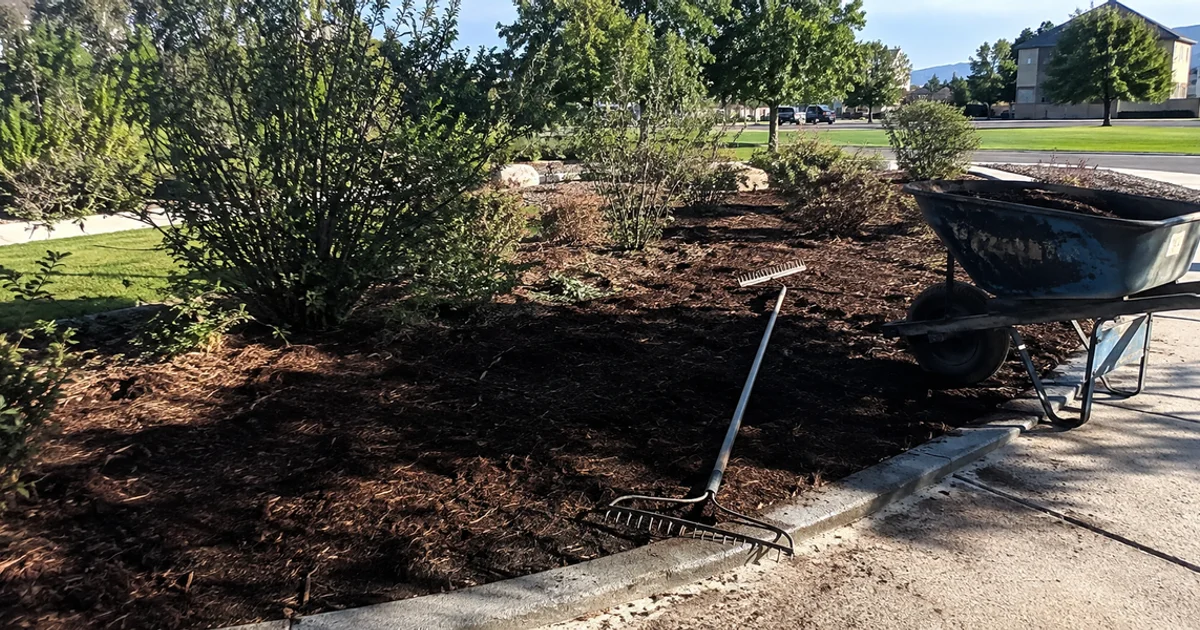
What you’re actually paying for
Mulch is priced by volume and installed by area and depth. A bed needs enough depth to block light, which is what suppresses weeds, without smothering the plants in it. Too thin and it doesn’t work; too thick and you cause problems at the crown of plants and around trunks.
Rather than quoting per cubic yard, we quote by bed area and target depth. It’s a more honest comparison, because two contractors quoting “per yard” can deliver very different results depending on the depth they spread it to. Mulching is a standard part of our tree and plant installation work.
Mulch types
Bark mulch. The most common choice for planting beds. Breaks down over time, adding organic matter to soil that in this valley usually needs it. Available in different grades and colours, with coarser grades lasting longer.
Wood chips. Chunkier and slower to break down. Good for paths, tree rings and larger informal areas. Less refined-looking in a front-yard bed.
Composted mulch. Finer, darker, and more actively soil-improving. Breaks down fastest, so it needs refreshing more often.
Decorative gravel and rock. Not organic mulch at all, but it fills the same role in a bed. It lasts indefinitely and never needs topping up, which is why it dominates water-wise Utah landscaping.
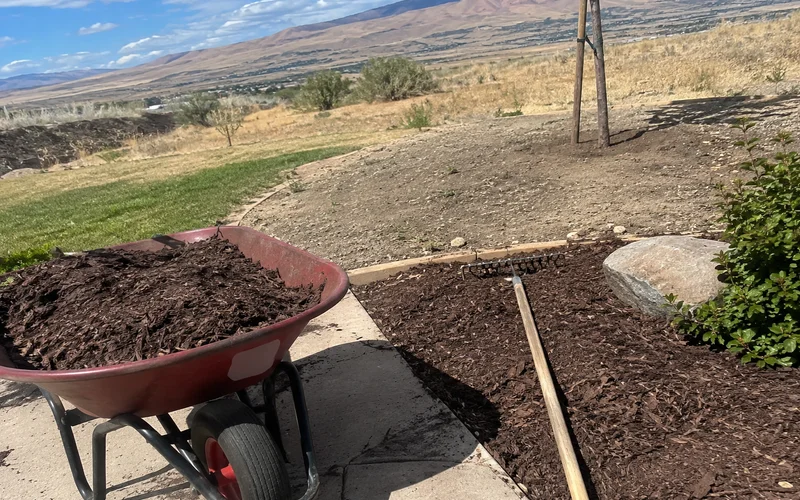
What mulch actually does for you
Cuts evaporation. Bare soil in a Utah summer loses moisture fast. A mulch layer slows that considerably, which means less irrigation for the same plant health.
Suppresses weeds. Weed seeds need light. Enough mulch depth denies it to most of them. You’ll still get some germinating in the mulch layer itself, but they pull out easily because they haven’t rooted into soil.
Moderates soil temperature. Root zones stay cooler in summer heat and buffered through winter freezes. Both reduce stress on plants, which is why mulch goes down on every tree we plant — see when is the best time to plant trees in Utah for how that fits the planting season.
Improves soil over time. Organic mulch breaks down into the soil beneath, adding structure and organic matter. On the compacted, low-organic soils common on new builds here, that matters.
Looks finished. A mulched bed with a crisp edge reads as designed. The same bed with bare soil reads as unfinished.
The value calculation
Mulch is one of the cheapest things you can put in a landscape and one of the highest-return. It reduces water use, reduces weeding time, improves soil, and makes the whole bed look intentional. Very little else in a yard does four useful jobs at once for the same money.
The annual refresh
Organic mulch breaks down: that’s a feature, not a fault, since it’s feeding the soil. The practical consequence is that depth and colour fade over a season, so beds typically want a top-up roughly annually.
That’s an ongoing cost, and it’s the main argument for decorative gravel in beds where you don’t need the soil improvement. Gravel costs more up front and essentially never needs replacing.
Where mulch beats gravel and vice versa
Choose mulch when: the plants prefer cooler root zones, the soil needs improving, the bed is under trees where organic matter naturally accumulates anyway, or you want a softer, more traditional look.
Choose gravel when: you want the lowest possible ongoing maintenance, the bed is planted with drought-tolerant species that like heat and sharp drainage, or you’re building a water-wise landscape where longevity matters more than soil enrichment.
Our guide comparing gravel and rock versus mulch for low-water Utah beds goes into the trade-off in more detail.
Common mistakes
- Piling mulch against trunks. Traps moisture against bark and invites rot. Leave the trunk flare exposed.
- Spreading too thin to save money. Below the depth that blocks light, mulch does almost nothing for weeds.
- Laying plastic sheeting underneath. It holds water, breaks down into shreds, and creates a worse problem than it solves. Woven geotextile is the right product where fabric is warranted.
- Skipping the edge. Without a physical edge, mulch migrates into the lawn and the bed line disappears.
If you want a real number for your beds, a free on-site visit gives you the area, the depth and the cost, itemized.