
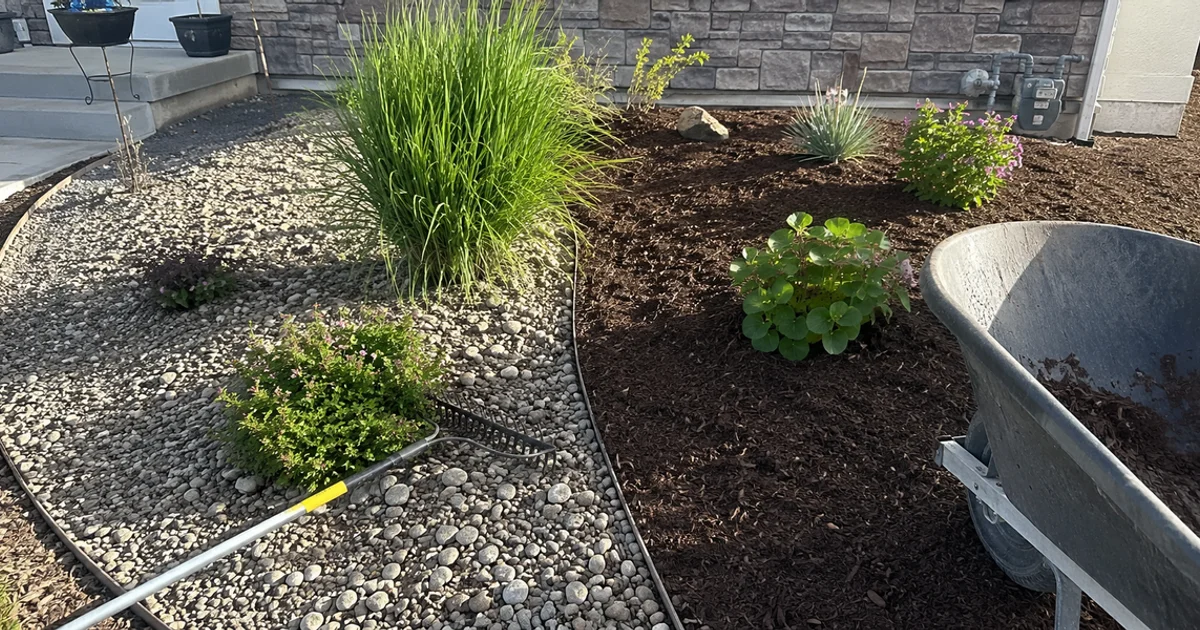
They do the same job differently
Both gravel and mulch cover bare soil in a planting bed, and both suppress weeds, reduce evaporation and make a bed look finished. Where they differ is what happens over time and what the plants underneath them prefer.
This comes up on almost every gravel and edging project, and the answer isn’t universal. If gravel is the direction you’re leaning, the decorative gravel and rock options for Utah landscapes covers which materials suit which beds.
Side by side
| Decorative gravel | Bark mulch | |
|---|---|---|
| Lifespan | Effectively permanent | Breaks down, top up annually |
| Up-front cost | Higher | Lower |
| Long-term cost | Very low | Recurring |
| Soil improvement | None | Yes, adds organic matter |
| Weed suppression | Very good at proper depth | Good, declines as it thins |
| Water retention | Good | Very good |
| Heat at soil level | Warmer | Cooler |
| Wind resistance | Excellent | Lighter grades blow |
| Look | Crisp, contemporary, desert | Soft, natural, traditional |
| Best plant match | Drought-tolerant, Mediterranean | Woodland, shrubs, perennials |
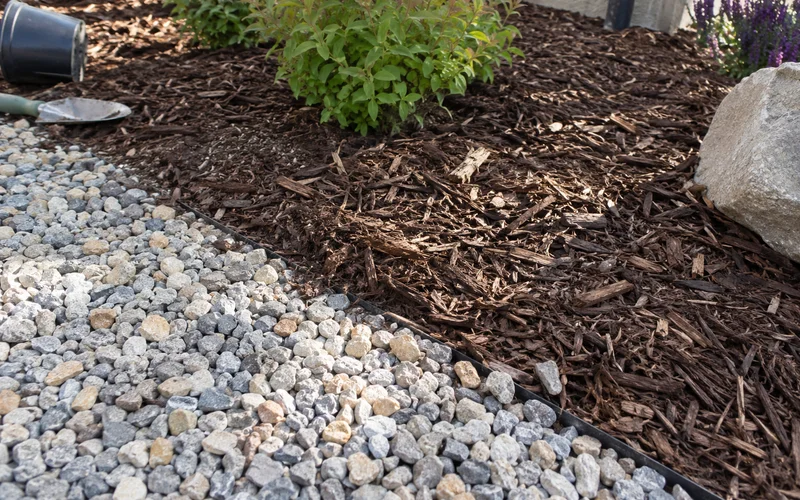
Water retention
Both reduce evaporation from the soil surface substantially compared to bare ground, which is the main reason either exists in a dry climate.
Mulch has a slight edge here. It holds moisture within its own layer and moderates soil temperature more effectively, keeping the root zone cooler and reducing the rate at which soil dries.
Gravel still cuts evaporation significantly, but it also absorbs and radiates heat, which raises soil temperature slightly. For drought-adapted plants that’s often fine or even beneficial. For plants that want a cool root zone it isn’t ideal.
Longevity and total cost
This is where gravel makes its case. Organic mulch decomposes. That’s what it’s supposed to do, and the resulting soil improvement is real value. But it means depth reduces and colour fades over a season, so beds need topping up roughly annually.
Gravel doesn’t decompose. Installed at proper depth over quality geotextile, it stays put more or less indefinitely. Occasional raking to redistribute and clearing accumulated debris is the extent of it.
Over a few years those recurring mulch top-ups add up. Over a decade the comparison is decisive. Over two or three seasons, mulch is cheaper.
Soil improvement
The one thing gravel cannot do. Mulch breaking down feeds organic matter into the soil beneath it, improving structure, water-holding capacity and biological activity.
On the compacted, low-organic soils common on Utah new builds, that matters. If a bed’s soil is poor and the planting would benefit from it improving over time, mulch is doing useful work that gravel doesn’t.
The honest split
Gravel for water-wise beds with drought-tolerant planting, front yards, park strips and anywhere low maintenance is the priority. Mulch for shrub borders, beds under trees, anything with plants that want cooler roots, and soils that need improving. Plenty of yards use both, in different beds.
Heat and plant choice
Gravel raises soil temperature and reflects heat upward. Silver-foliaged Mediterranean plants, ornamental grasses and desert-adapted species generally do well with that. Many prefer the sharp drainage and warmth at the crown.
Woodland-type plants, most shrubs that naturally grow with leaf litter around them, and anything that struggles in a hot exposed position do better under mulch.
On a hot, west-facing bed against a reflective wall, gravel compounds an already stressful microclimate. That’s a mulch situation regardless of the water-wise argument.
Weeds
Both suppress weeds from below when installed at proper depth over quality fabric. Neither stops seeds blowing in from above.
Gravel’s advantage is that it maintains depth indefinitely, so its suppression doesn’t decline. Mulch thins as it decomposes, and a mulched bed left un-topped for two seasons will start letting weeds through.
Gravel’s disadvantage is that weeds germinating in the dust that accumulates in the rock are more annoying to pull, since roots grip between stones.
For what mulch actually costs to install and maintain, see our guide on mulching cost.