
The basic idea
Drip irrigation delivers small amounts of water slowly, directly at the base of individual plants, rather than throwing it across an area. Because the application rate is low, the soil absorbs it as it arrives instead of pooling or running off. And because there’s no spray in the air, virtually nothing is lost to evaporation or wind.
That’s the entire principle behind drip irrigation installation, and in a dry, windy climate like ours it makes a real difference to consumption.
The components
The zone valve. Drip runs off a standard irrigation valve, controlled by the same controller as your spray zones. Nothing exotic.
Filter. Essential. Drip emitters have very small openings, and any sediment in the water will block them. On secondary water this matters even more, since untreated canal water carries silt.
Pressure regulator. Drip components are designed to run at much lower pressure than spray heads. Feed them full line pressure and you’ll blow fittings apart. The regulator brings it down to what the system is rated for.
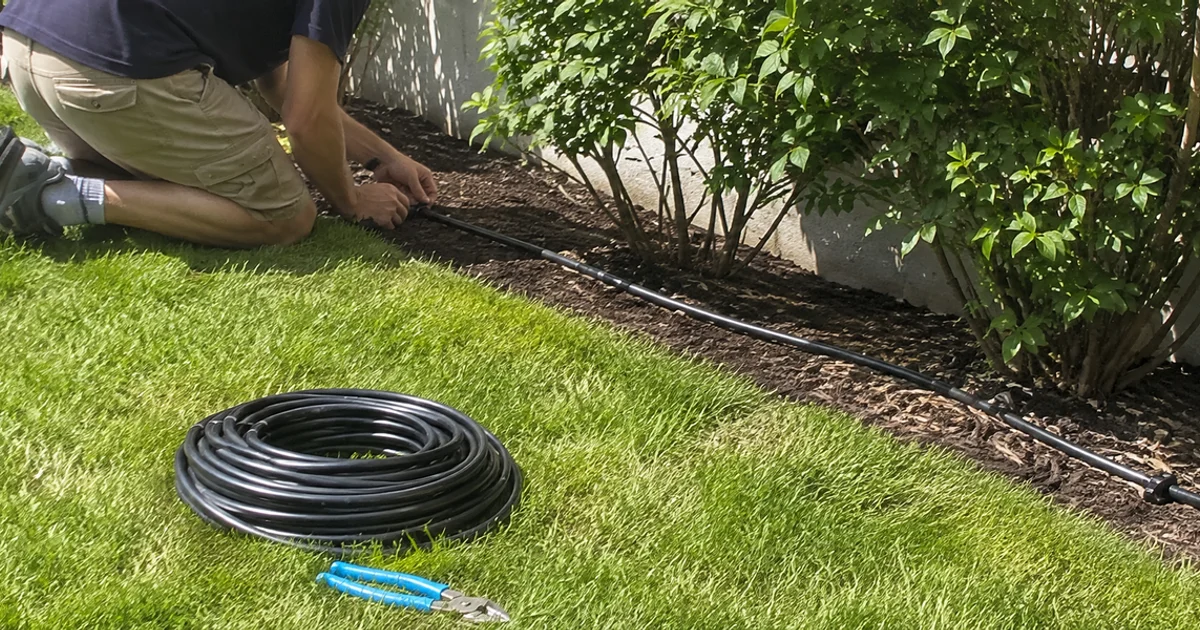
Poly tubing. Flexible mainline tubing routed through the bed, following the planting rather than a grid. It sits on the soil surface, usually under mulch or gravel.
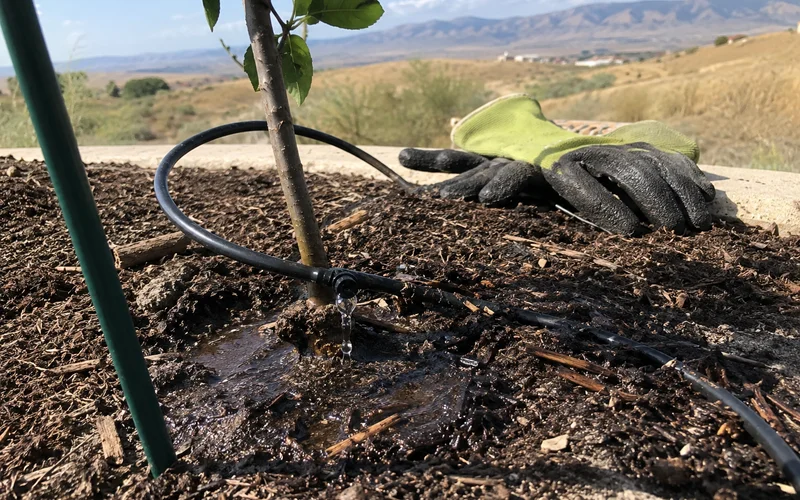
Emitters. The devices that meter water out at a specific rate. Commonly available in several flow rates so you can match output to plant size. Some are inserted into the tubing where you need them; some come pre-installed at fixed spacing in emitter line.
End caps and flush points. So the lines can be flushed periodically to clear anything that gets past the filter.
Where drip belongs
Planting beds. The classic application. Shrubs, perennials and ornamental grasses all do better with deep, targeted water at the root zone than with overhead spray.
Trees. Especially newly planted ones. Emitters positioned out toward the drip line encourage roots to spread outward rather than staying near the trunk.
Containers and pots. A single emitter per pot on a drip zone removes the daily hand-watering chore entirely.
Water-wise and xeriscape beds. Drip is the standard for these, and it’s typically required for turf-replacement rebate eligibility.
Vegetable gardens. Targeted water at the root zone, dry foliage, fewer disease problems.
Where drip doesn’t belong
Lawns. Turf needs even coverage across a continuous surface. Subsurface drip for turf exists but is specialist and rarely the right answer for a residential yard here. Spray or rotor heads are the correct tool.
Anywhere you need visible confirmation it’s running. Drip is invisible by design, which is a feature until something fails silently. This is why flow monitoring and periodic inspection matter.
Emitter sizing is where drip is done well or badly
A newly planted tree and a small perennial in the same bed do not want the same amount of water. Running one flow rate across an entire bed is the drip equivalent of putting beds on a lawn zone. Emitters should be sized per plant.
How drip integrates with an existing system
This is the part most homeowners don’t realise is affordable. If you already have a sprinkler system, converting a bed to drip usually doesn’t mean new valves or new trenching. A drip zone can run off an existing valve, with a filter and pressure regulator added at that zone and tubing routed through the bed.
Where a bed currently shares a turf zone, we sometimes convert that zone entirely, or split it. Either way it’s far less work than people assume.
Scheduling drip
Drip zones run longer and less often than spray zones. The application rate is deliberately slow, so a meaningful soak takes time, but because it goes deep and doesn’t evaporate, you need it far less frequently.
Setting a drip zone on a turf schedule is the most common configuration mistake. We set a starting schedule at handover and explain how to adjust it seasonally.
For a direct comparison of the two approaches in beds, see our guide on drip versus spray.