
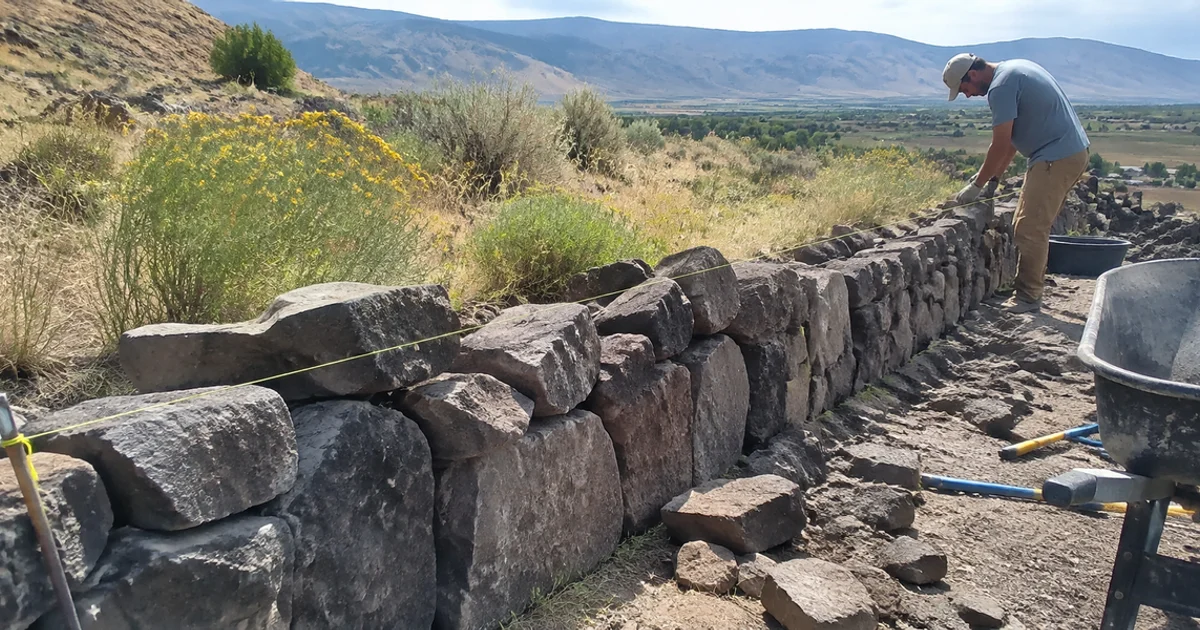
Stone that matches its setting
On a rural Tooele County property with open ground, native rock visible and the Oquirrhs behind you, a manufactured block wall can look imported. A boulder wall built from basalt or fieldstone looks like it grew out of the site.
That’s the main reason people choose them, and it’s a good reason. Appearance is a legitimate design criterion, and matching material to setting is what makes a landscape feel settled rather than installed. It’s the core of our rock walls work.
The materials
Basalt. Dark, dense volcanic rock with an angular character. Reads strongly against lighter ground and pairs well with green planting. Common and locally available.
Granite. Lighter and more varied in colour, often with visible crystalline texture. A softer look than basalt.
Natural fieldstone. Weathered, irregular, often with lichen and age already on it. The most rustic of the three, and the one that looks least like it arrived last week.
Which suits your property usually comes down to what’s already visible in the surrounding landscape and what colour your house is.
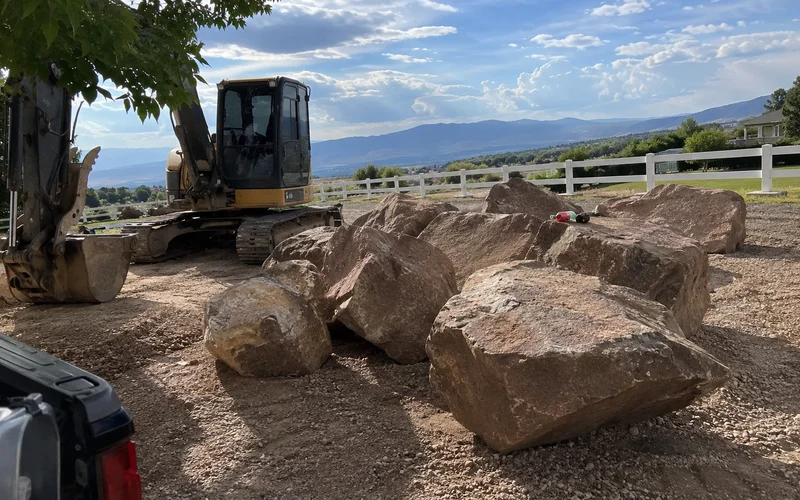
Placement is the craft
Building a boulder wall is not stacking rocks. Every stone has a good face and several bad ones, and the wall’s whole appearance depends on which face is turned outward and how each stone sits against its neighbours.
Our process is to stage the boulders on site first, so we’re choosing from actual stones rather than working from a delivery order. Then each one is placed with the excavator, turned and adjusted until the face reads right, and bedded into an excavated position rather than perched on the surface.
Bedding matters structurally, not just visually. Stones set on undisturbed ground move as the soil settles and water works underneath them. Excavating and setting each boulder into the ground, keyed against its neighbours, is what keeps a wall in line for decades.
What we won’t do
Sell you a boulder wall where the slope needs an engineered retaining system. Rock walls handle decorative and light retaining applications well. When there’s real height with soil and water behind it, that’s a different structure, and we’ll say so during the estimate rather than after the wall moves.
Where boulder walls work well
- Defining a driveway or property edge on acreage
- Low retaining on a modest bank
- Terracing a rural slope in stepped runs with planting between
- Accent groupings that give an open yard some structure
- Around water features and dry creek beds, where natural stone is the obvious material
- Slopes where planting pockets help. The gaps between stones take drought-tolerant perennials whose roots then help hold the slope
Where a segmental wall is the better answer
- Tall walls holding significant grade
- Anywhere something loads the ground above: a driveway, parking, a structure
- Tight subdivision lots where the scale of boulders is wrong for the space
- Situations requiring stamped engineering
- Where machine access can’t reach the wall line, since large stone can’t be placed by hand
Our guide comparing retaining wall versus rock wall goes through the decision in more detail.
Planting into the wall
The gaps between boulders are an opportunity most people miss. Soil pockets between stones take drought-tolerant perennials, low shrubs and ornamental grasses that soften the stone visually and root into the slope behind it.
A boulder wall with mature planting spilling between the stones looks like part of the landscape. The same wall left bare looks like a delivery. It’s worth planning the planting at the same time as the stone.