
Grading is the invisible half of a landscape
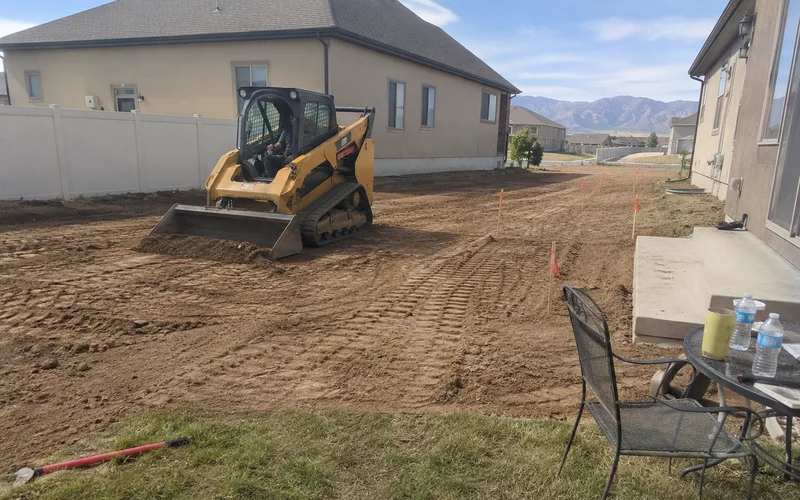
Everything you can see in a yard sits on the grade. Get it right and water leaves the property the way it should, the lawn drains, planting beds don’t waterlog and the foundation stays dry. Get it wrong and nothing built on top fixes it.
That’s why grading is the first physical phase of almost every project we do, and why it’s the phase that most often gets shortchanged on a cheap bid. It’s completely invisible once sod is down.
Positive drainage, and why builders don’t provide it
Positive drainage means the ground falls away from the house in every direction, so water moves outward and off rather than toward the building.
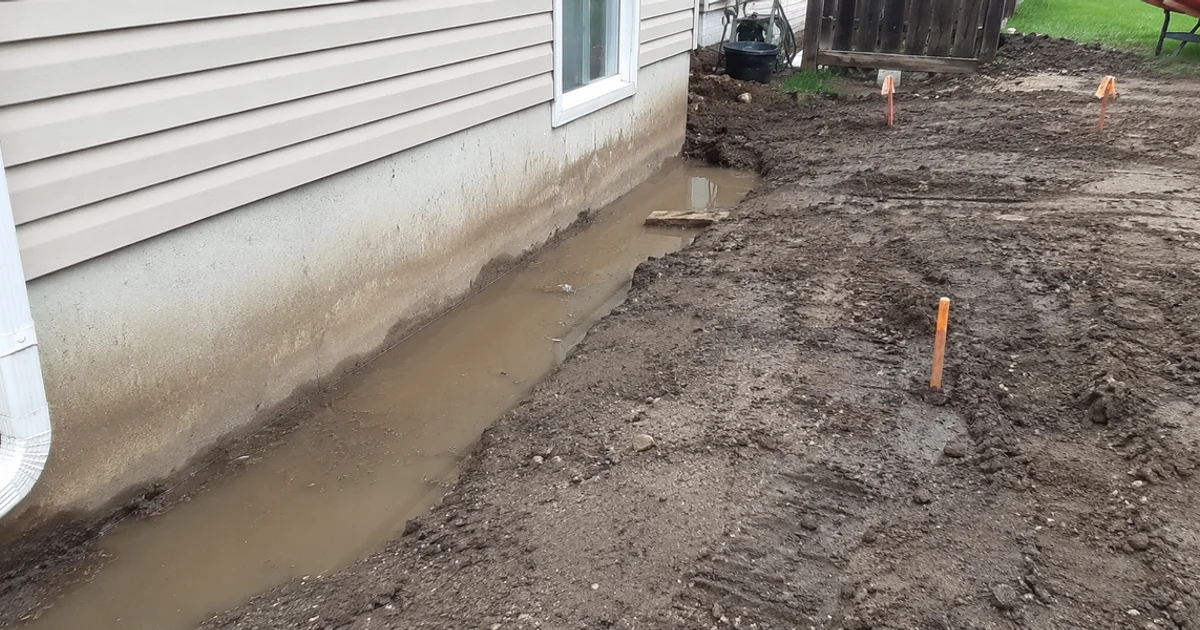
New construction rarely delivers it. Builders grade for construction access and to move machinery around the site. Backfill around a foundation is placed quickly and settles over the following years, and a slope that was marginal at handover can reverse entirely by year three.
We see the results constantly in newer subdivisions across Stansbury Park, Herriman and Eagle Mountain: ground sloping gently back toward the foundation, window wells collecting water, and low spots that hold puddles for days after a storm.
What poor grading actually costs
Foundation damage. The expensive one. Water against a foundation finds its way in through cracks and joints, and in our climate the freeze-thaw cycle works on any moisture it finds. Persistent saturation is a structural issue, not a nuisance.
Wet basements and window wells. Directly downstream of the same problem.
Drowned lawns. Grass roots need air as well as water. Ground that stays saturated kills turf from the roots up, and the dead patches get blamed on disease or irrigation when the cause is standing water.
Failing planting beds. Most drought-tolerant and adapted species used in Utah landscapes hate wet feet. A bed sitting in a low spot kills plants that would be fine three metres away.
Erosion. Runoff moving faster than the ground can absorb takes soil with it. On slopes that’s an ongoing loss.
Ice. Water pooling on paths and driveways in winter is a genuine safety problem.
Swales and runoff management
Sometimes reshaping the general grade isn’t enough, particularly where a property receives runoff from uphill or from adjacent hard surfaces.
A swale is a shallow, deliberately sloped channel that collects that flow and carries it to a safe outlet. Built well it’s barely visible. A gentle dip in the lawn that grass grows over and a mower runs across without noticing.
Swales handle far more volume than a general slope, and on rural or hillside lots they’re often the difference between a landscape that survives spring snowmelt and one that gets rearranged by it.
The test you can do this week
After the next real storm, walk the property. Note where water is standing an hour later, whether any of it is against the house, and whether the window wells are wet. That’s your grading report, and it costs nothing.
When to call for grading
- Water pools anywhere for more than a few hours after rain
- Any water reaches the foundation or the window wells
- The basement is damp after storms or during snowmelt
- Soil is washing off a slope
- Grass won’t grow in a persistently soft area
- You’re about to lay sod or build a patio. This is the moment, before anything covers the ground
- You’ve just taken delivery of a new build, where the grade almost always needs correcting
That last one is worth emphasising. On a new-construction install, grading is the phase everything else depends on, and it’s the cheapest it will ever be to do, because the yard is already open.