
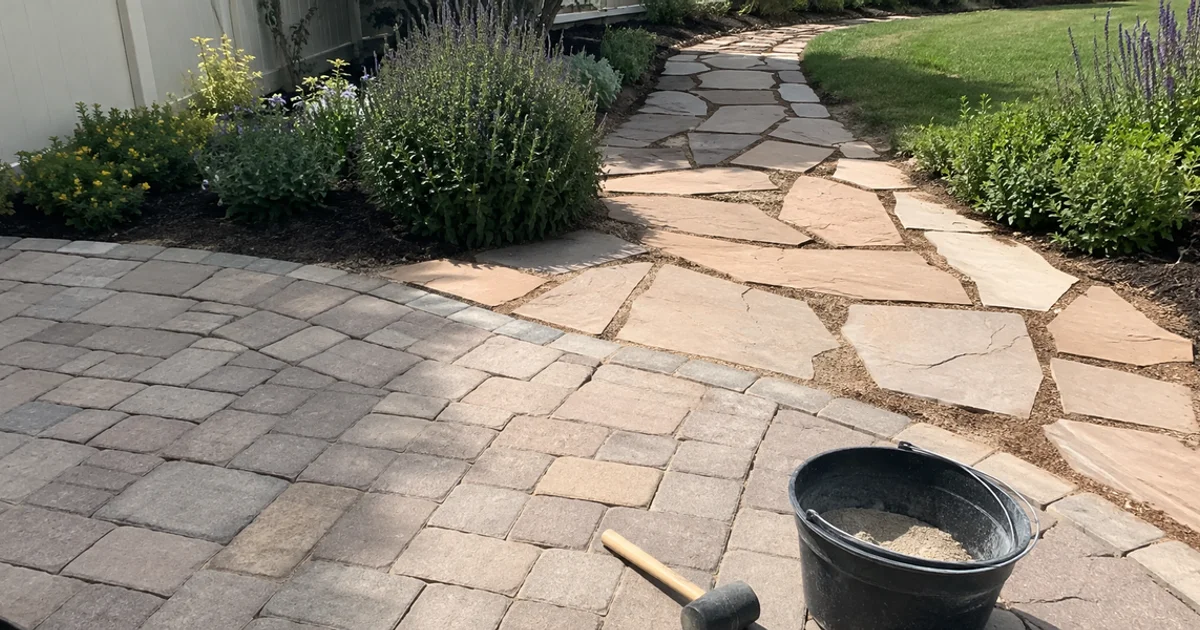
Utah winters are the deciding factor
Patio material choice elsewhere is mostly about appearance and budget. Here, freeze-thaw cycling should lead the decision, because it’s what determines whether the patio still looks good in ten years.
Water gets into and under a hard surface. It freezes, expands, and pushes. Then it thaws and does it again, dozens of times a season. A material that can accommodate that movement survives it. A material that can’t, cracks. That’s the practical foundation of every patios and outdoor living recommendation we make.
Side by side
| Pavers | Poured concrete | Flagstone | |
|---|---|---|---|
| Freeze-thaw performance | Excellent. Joints flex | Poor. Cracks are permanent | Good. Individual pieces move |
| Repairability | Lift and replace one unit | Patch or replace a slab | Lift and reset a piece |
| Up-front cost | Middle | Lowest | Highest |
| Labour intensity | Moderate | Low | High |
| Look | Uniform, patterned, wide colour range | Plain unless finished | Natural, irregular, organic |
| Design flexibility | High: curves, borders, patterns | Moderate | High but freeform |
| Surface underfoot | Even | Very even | Slightly uneven |
| Longevity with good base | Decades | Decades until it cracks | Decades |
| Base requirement | Compacted road base, critical | Compacted base plus reinforcement | Compacted road base, critical |
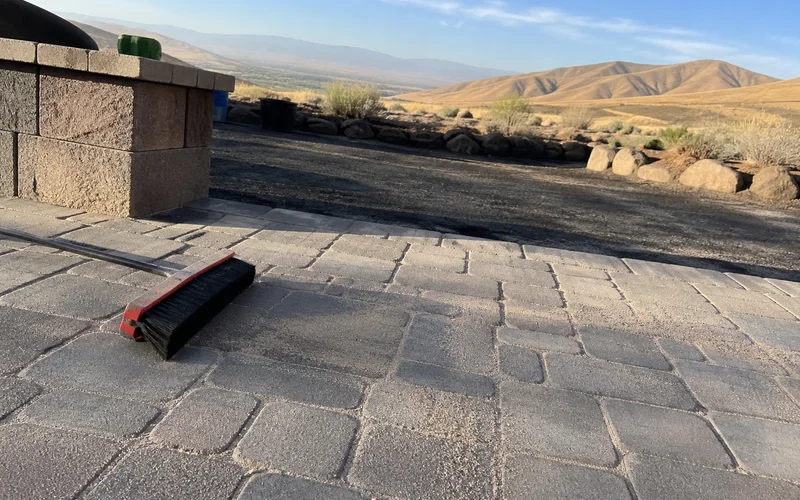
Pavers
Interlocking concrete units laid on a compacted base and bedding layer, with polymeric sand swept into the joints.
Why they suit our climate. The field is made of many small pieces with flexible joints. When the ground moves seasonally, the field accommodates it rather than fracturing. Small settlements can be corrected by lifting a section, adjusting the base and relaying.
Repairability is the underrated advantage. Barbecue grease stain, a cracked unit, a section that settled: lift it out, fix what’s underneath, put it back. Nobody can tell.
Design range. Curves, borders, contrasting bands, circular features. Pavers do things a slab can’t without expensive formwork.
Trade-off. Higher up-front cost than plain concrete, and polymeric sand joints need occasional attention over the years.
Poured concrete
A monolithic slab, usually with control joints cut in to encourage cracks to happen where you want them.
Why people choose it. Lowest up-front cost for a plain finish, fast to install, and an even surface with nothing to catch a chair leg.
The problem here. Concrete cracks. Control joints manage where, not whether. Once a crack forms outside a joint it’s permanent. Patching is visible, and the only real fix is replacing the section.
Where it makes sense. Utility areas, side yards, sheds, anywhere appearance is secondary. Also under a covered patio where exposure is reduced.
Flagstone
Natural stone slabs, laid dry on a base with gravel or sand joints, or mortared onto a slab.
Why people choose it. Nothing else looks like it. Irregular natural shapes, colour variation, and a settled, established appearance from day one. It suits rural and hillside properties in Tooele County particularly well.
Cost driver is labour. Each piece is individually selected, positioned and often trimmed. That’s slow work compared to laying a repeating paver pattern.
Performance. Individual pieces can move and be reset, so it handles freeze-thaw reasonably. Dry-laid flagstone drains well. Mortared flagstone on a slab inherits the slab’s crack behaviour.
Trade-off. The surface is slightly irregular, which is part of the appeal but worth considering for furniture stability and accessibility.
What matters more than any of this
Base preparation. A flagstone patio on a properly excavated and compacted road base outperforms a paver patio laid on four inches of whatever came out of the hole. Every one of these materials fails on a bad base, and every one of them lasts on a good one.
What we’d recommend
For a main back-yard living area in a Utah climate: pavers. Best freeze-thaw performance, repairable, wide design range, and the cost sits between the other two.
For a natural or rural property where the look leads: flagstone, budget allowing.
For a utility area, a shed pad or a side yard where appearance doesn’t matter much: concrete.
For what any of them cost, see our guide on paver patio cost in Utah.